
Feeling Overwhelmed by Anxiety? Discover What Your Symptoms Mean and Find Relief Today
Understand anxiety symptoms across physical, psychological, emotional, and behavioral domains. Learn when to seek professional help, evidence-based treatments like CBT, and self-help techniques you can start today.
In this article
If your heart is racing, your thoughts won't slow down, and something feels deeply wrong — even when you can't explain why — you are not alone, and you are not imagining it. Anxiety is one of the most common human experiences, affecting an estimated 31.1% of adults at some point in their lives. Yet for most people living through it, anxiety feels uniquely isolating: a private experience of dread that others cannot see and that is difficult to put into words.
Anxiety symptoms manifest across four interconnected domains. Physically, you may notice a racing heart, chest tightness, muscle tension, nausea, or breathlessness — your body's fight-or-flight response activating without a visible threat. Psychologically, excessive worry, rumination, and catastrophizing can make it impossible to think clearly. Emotionally, intense fear, irritability, and a pervasive sense of dread can color every part of your day. Behaviorally, anxiety quietly reshapes your life through avoidance, withdrawal, and disrupted routines.
Understanding what your symptoms mean is the crucial first step toward relief. Experiencing anxiety does not mean something is fundamentally broken in you — it means your brain's protective system is working overtime. And with the right knowledge and support, these symptoms are manageable.
Key Takeaways
You Don't Have to Navigate Anxiety Alone — Get AI Mental Support Right Now
Feeling anxious at this moment? Chat with Dzeny, our online AI therapist, for immediate guidance — no appointment needed, no judgment, just genuine help available 24/7 whenever you need it most.
Start Free Chat with DzenyDisclaimer: Medical Information
Educational Purpose: This article provides educational information about anxiety symptoms and is not intended to replace professional medical advice, diagnosis, or treatment. Expert Consultation: If you are experiencing severe anxiety symptoms, having thoughts of self-harm, or if anxiety is significantly impacting your daily life, please consult with a qualified healthcare provider immediately. Safety First: Always seek the advice of your physician or other qualified health provider with any questions you may have regarding a medical condition. Individual Responsibility: Never disregard professional medical advice or delay seeking it because of something you have read in this article.
Understanding Anxiety: From Normal Response to Clinical Concern
Anxiety is not a flaw, a weakness, or a sign that something has gone wrong with your character. It is one of the most fundamental and universal human experiences — an evolved protective mechanism that has kept our species alive for hundreds of thousands of years. The racing heart before a difficult conversation, the unease before a medical appointment, the alertness before a job interview: these are anxiety doing exactly what it is designed to do.
The challenge is that this same system, so useful in genuine danger, can activate in contexts where no real threat exists — or can sustain itself far beyond the point where it serves any protective purpose. Understanding the difference between anxiety as a normal, adaptive response and anxiety as a clinical condition requiring support is the foundation of everything that follows.
The key distinction is not whether you feel anxious — it is whether anxiety is running your life. Normal anxiety is proportionate, temporary, and tied to a specific trigger. Clinical anxiety is persistent, often disproportionate to the situation, and significantly interferes with your ability to function and experience your life.
The Anxiety Spectrum: From Normal to Clinical
Normal Anxiety (Adaptive):
- Proportionate to the actual situation or stressor
- Resolves when the stressor passes or is addressed
- May actually improve performance (moderate arousal optimizes focus)
- Does not significantly interfere with daily functioning
- Examples: nerves before a presentation, worry after receiving difficult news
Mild-to-Moderate Anxiety (Situational):
- Somewhat disproportionate or persisting longer than the stressor warrants
- Manageable with self-help strategies and lifestyle adjustments
- Mild impact on functioning — some avoidance or disrupted sleep
- Examples: ongoing worry during a stressful period at work or in a relationship
Disorder-Level Anxiety (Clinical):
- Persistent, excessive, and often disproportionate to actual circumstances
- Significantly interferes with work, relationships, self-care, or leisure
- Present most days for weeks or months, not just during stressful periods
- Resistant to self-reassurance and self-help efforts alone
- Examples: GAD, Panic Disorder, Social Anxiety Disorder — see dedicated section below
The Biology Behind Your Symptoms
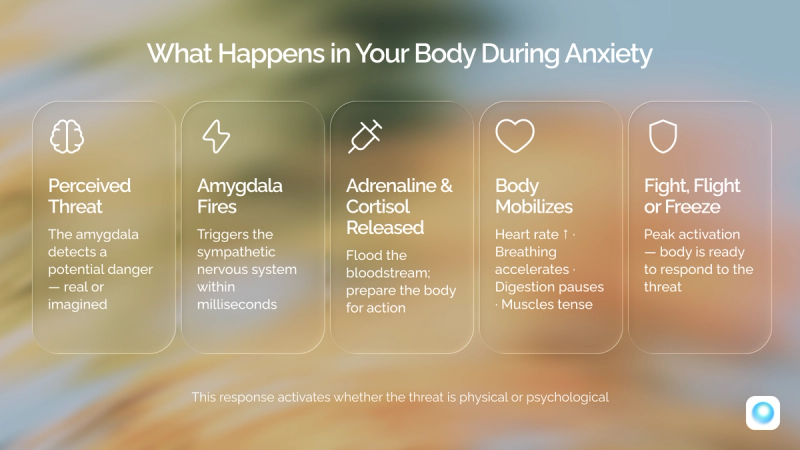
When you experience anxiety, your body is doing exactly what millions of years of evolution designed it to do. The amygdala — a small, almond-shaped structure deep in the brain — detects what it interprets as a threat and immediately triggers the sympathetic nervous system, initiating the fight-or-flight response. Within milliseconds, adrenaline and cortisol flood your bloodstream. Your heart rate increases to pump more blood to your muscles. Breathing accelerates to take in more oxygen. Non-essential systems — including digestion — slow down or pause.
This cascade is extraordinarily effective at preparing you to fight or flee from physical danger. The problem is that your amygdala cannot reliably distinguish between a charging predator and an upcoming difficult conversation. It responds to perceived threat — and in modern life, perceived threats are everywhere: emails, deadlines, social judgments, financial uncertainty, health fears.
A useful way to understand your anxiety symptoms is the smoke alarm analogy. A smoke alarm cannot tell the difference between burning toast and a house fire — it simply detects smoke and sounds the alarm. Your anxiety system works the same way. The alarm is not malfunctioning. Understanding this is not just intellectually interesting — it actively reduces the fear of symptoms, which itself can break part of the anxiety cycle.
When Anxiety Crosses the Line: Recognizing Disorder-Level Symptoms
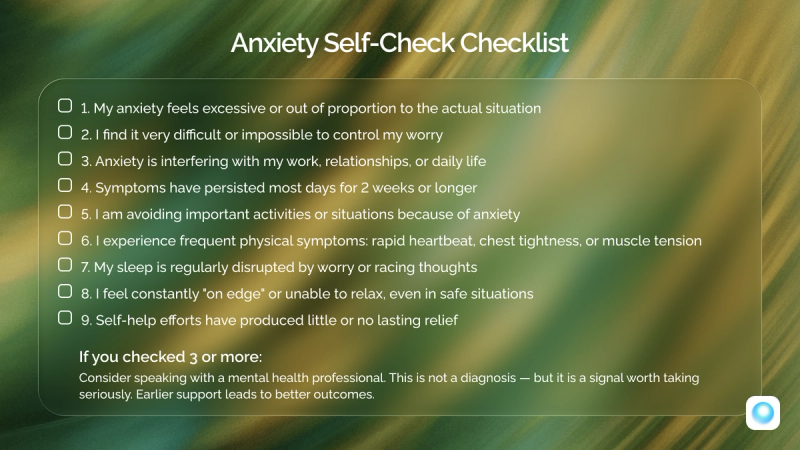
The DSM-5 (Diagnostic and Statistical Manual of Mental Disorders, Fifth Edition) provides the clinical criteria that distinguish disorder-level anxiety from normal anxious experience. Translated into plain language, the key markers are three: the anxiety is excessive relative to the actual situation; it is difficult or impossible to control despite your best efforts; and it causes significant interference with your daily functioning.
Functional impairment is the decisive criterion. Anxiety becomes a clinical concern not simply because it is intense or frequent, but because it is preventing you from living the life you want to live. Missing work because you can't face a difficult colleague. Declining social invitations you genuinely want to attend. Sleeping poorly for weeks. Avoiding the doctor out of fear of bad news. These are the signals that anxiety has moved from a normal response into a condition that deserves professional attention.
Physical Symptoms of Anxiety: When Your Body Sounds the Alarm
You are not imagining the physical symptoms of anxiety. They are real, measurable physiological events — the direct result of your nervous system activating the fight-or-flight response. The racing heart, the tight chest, the nausea, the shaking hands: all of these are your body preparing to deal with a threat it has detected, even when no external danger is visible.
While all ten symptoms above are common in anxiety, none should be assumed to be anxiety without a medical evaluation ruling out physical causes — especially chest pain, palpitations, significant shortness of breath, or new neurological symptoms. If you are experiencing these symptoms for the first time, consult a physician before attributing them to anxiety.
Struggling with Physical Symptoms? Get Personalized Support and Relief Techniques Now
Anxiety's physical symptoms can feel frightening and overwhelming. Dzeny helps you understand what you're experiencing, provides grounding techniques, and creates a personalized plan for managing your symptoms effectively.
Talk About Your SymptomsPsychological and Emotional Symptoms: What's Happening in Your Mind
The physical symptoms of anxiety are often the most alarming, but it is frequently the psychological and emotional symptoms that are most exhausting to live with. Excessive worry that you cannot turn off. Thoughts that spiral toward worst-case scenarios no matter how many times you reassure yourself. A persistent sense of dread without a clear source. The feeling that you are somehow flawed or broken because your mind won't settle.
These are not personality defects. They are symptoms — recognizable, well-documented patterns that emerge from the same neurobiological processes that produce anxiety's physical manifestations. The anxious mind is not weak or irrational; it is hypervigilant. It has learned to scan constantly for threat, to treat uncertainty as danger, and to prioritize protection over present-moment engagement. Understanding this does not make the experience pleasant — but it does make it comprehensible, and comprehensible experiences are far more manageable than mysterious ones.
Cognitive Behavioral Therapy (CBT), the gold-standard treatment for anxiety disorders, is built on a foundational insight: our thoughts, feelings, and behaviors are interconnected. Changing one changes the others. The psychological work of managing anxiety begins with recognizing the thought patterns that fuel it — not to dismiss or suppress them, but to examine them and, gradually, to change them.
Recognizing Thought Patterns That Fuel Anxiety
Cognitive distortions are patterns of thinking that are systematically inaccurate — they amplify perceived threat, underestimate our capacity to cope, and maintain anxiety by giving the anxious mind a constant supply of alarming material. The most important thing to understand about cognitive distortions is that they do not feel distorted. They feel accurate. Catastrophizing feels like realistic risk assessment. Rumination feels like productive problem-solving. Mind-reading feels like social awareness.
Recognizing these patterns — simply naming them when they occur — breaks their automatic power. You cannot usually stop the thought. You can learn to see it for what it is. The table below describes the five most common anxiety-fueling thought patterns, with examples and a reframe for each.
| Thought Pattern | What It Looks Like | A More Balanced Frame |
|---|---|---|
| Catastrophizing (Jumping to worst case) | "My heart is beating fast — something must be seriously wrong. What if it's a heart attack?" | "My heart is beating fast. This often happens with anxiety. I've felt this before and it has always passed." |
| Rumination (Repetitive negative replay) | "I can't stop thinking about what I said in that meeting. Everyone must think I'm incompetent." | "I've been replaying this for an hour. Replaying it more won't change what happened. I can address it directly if needed." |
| Excessive Worry (Uncontrollable 'what ifs') | "What if I fail the exam? What if I lose my job? What if something happens to my family?" | "I'm worrying about multiple things at once. Most of these outcomes are unlikely. What is actually within my control right now?" |
| All-or-Nothing Thinking (Black-and-white) | "I made one mistake — I've ruined everything. I either do this perfectly or I've failed completely." | "One mistake in an otherwise competent performance. What would I say to a friend in this situation?" |
| Mind-Reading (Assuming negative judgment) | "Everyone in that conversation could tell I was anxious. They all think less of me now." | "I'm assuming I know what others were thinking. Most people are focused on themselves. I don't actually know what they thought." |
These patterns are not character flaws or evidence of irrationality. They are cognitive habits, developed as protective strategies, that have become counterproductive. Like all habits, they can be changed — but the change requires practice, not willpower.
Emotional Signs: More Than Just Feeling Worried
When most people think of anxiety, they think of worry and fear. But anxiety's emotional landscape is considerably broader — and some of its emotional manifestations are so unexpected that people do not recognize them as anxiety at all. Irritability, for instance, is a classic anxiety symptom that is routinely misattributed to a 'bad mood' or 'difficult personality'. Emotional numbness — a shutdown of feeling as a protective response — is often interpreted as depression when it is actually a consequence of prolonged anxiety.
Understanding these emotional experiences as symptoms — temporary states generated by your nervous system's threat response, not permanent features of your character — is one of the most practically important insights in anxiety management. You are not 'too sensitive'. You are not 'overreacting'. Your emotional system is responding to chronic activation in entirely predictable ways.
The Emotional Landscape of Anxiety
- Overwhelming Fear and Dread — pervasive sense that something terrible is about to happen, even when nothing specific is wrong. This 'free-floating anxiety' is one of the hallmarks of Generalized Anxiety Disorder.
- Irritability and Anger — low frustration threshold, snapping at people you care about, feeling easily annoyed by things that would not normally bother you. Reflects sympathetic nervous system activation, not a change in your character.
- Restlessness and Inner Agitation — inability to sit still, relax, or settle — a persistent internal 'buzzing' that makes stillness feel impossible.
- Emotional Numbness — a flattening of emotional experience, feeling disconnected or as if watching your life from behind glass. A protective shutdown response after prolonged alert.
- Mood Volatility — emotional responses that feel disproportionate or unpredictable — rapid shifts, feeling fine one moment and overwhelmed the next.
- Feeling Constantly 'On Edge' — baseline heightened alertness and tension, waiting for something to go wrong even in objectively safe situations.
Important
These are temporary emotional states, not personality traits. They emerge from chronic nervous system activation and respond to the same interventions as anxiety's other symptoms.
Behavioral Signs: How Anxiety Quietly Reshapes Your Life
Of all anxiety's manifestations, behavioral changes are often the most insidious — because they feel like reasonable, rational choices. Avoiding a social event because you feel anxious does not feel like a symptom; it feels like a sensible decision. Procrastinating on a task because the thought of it produces dread does not feel like anxiety driving your behavior; it feels like not being ready yet. Checking your phone compulsively for reassurance does not feel like a safety behavior; it feels like staying informed.
The difficulty is that these behavioral choices, while providing short-term relief, maintain and often strengthen anxiety in the long run. This is the central paradox of avoidance: it works immediately and makes things worse over time. Every avoided situation sends the brain a message that the threat was real and the avoidance was necessary. The anxiety that drove the avoidance is confirmed and strengthened.
Common Behavioral Patterns Driven by Anxiety
- Avoidance — staying away from people, places, situations, or thoughts that trigger anxiety.
- Safety Behaviors — always sitting near exits, rehearsing conversations obsessively, carrying specific objects.
- Reassurance Seeking — repeatedly asking others for reassurance, or compulsively checking news/health/social media.
- Procrastination — delaying tasks that produce anxiety: emails, difficult conversations, medical appointments.
- Social Withdrawal — cancelling plans, declining invitations, pulling back from relationships.
- Compulsive Behaviors — repetitive actions: checking, ordering, cleaning, excessive planning.
How Anxiety Impacts Your Daily Life
Anxiety does not stay contained within the moments of acute distress. It spreads — gradually but systematically — into the fabric of daily life. This spreading impact on functioning is both the clearest indicator that anxiety has reached clinical significance and the most important reason to address it proactively.
| Life Domain | How Anxiety Typically Interferes |
|---|---|
| Work and School | Difficulty concentrating; procrastinating on high-stakes tasks; missing deadlines; underperforming despite effort; avoiding presentations or evaluations; calling in sick on anxiety-heavy days |
| Relationships | Withdrawing from friends and family; difficulty being present in conversations; irritability creating conflict; avoiding intimacy; over-reliance on reassurance; difficulty asking for help |
| Physical Health | Neglecting medical and dental appointments out of health anxiety; disrupted sleep chronically affecting health; neglecting exercise and nutrition during high-anxiety periods |
| Social Life | Declining invitations that were previously enjoyable; canceling at the last minute; attending events but not enjoying them due to persistent monitoring for threat; gradually losing social connections |
| Hobbies and Interests | Abandoning enjoyable activities because they feel effortful when anxious; inability to be present in leisure activities; loss of pleasure and spontaneity |
| Self-Care | Difficulty maintaining consistent routines; skipping meals or eating for comfort; reduced self-compassion; neglecting basic needs during periods of intense anxiety |
Expert Tip — The ripple effect is reversible
The functional impairment anxiety creates tends to be gradual and self-reinforcing — but so is recovery. As symptoms improve, each life domain that was affected begins to recover. Work performance, relationship quality, social engagement, and physical health all respond to effective anxiety management. The losses are real but they are not permanent.
Common Anxiety Disorders and Their Unique Symptoms
'Anxiety disorder' is not a single diagnosis but a family of related conditions, each with a distinct symptom pattern, trigger profile, and treatment approach. Understanding the differences matters because the most effective treatment is tailored to the specific type of anxiety disorder — what works well for Generalized Anxiety Disorder may need significant modification for Panic Disorder or Social Anxiety.
The four disorders described below account for the vast majority of anxiety disorder diagnoses in adults. They frequently co-occur — having one anxiety disorder increases the likelihood of having another — and all of them respond well to evidence-based treatment.
| Disorder | Core Feature | Key Differentiator from Other Anxiety |
|---|---|---|
| Generalized Anxiety Disorder (GAD) | Excessive, uncontrollable worry across multiple life domains | Worry is pervasive and shifts between topics — not tied to one specific situation or trigger |
| Panic Disorder | Recurrent unexpected panic attacks plus persistent fear of future attacks | The panic attacks themselves are unexpected; fear of the next attack drives avoidance |
| Social Anxiety Disorder | Intense fear of social situations and perceived judgment by others | Anxiety is specifically triggered by social evaluation contexts, not general situations |
| Specific Phobia | Intense, irrational fear of a specific object or situation | Fear is circumscribed and predictable — only triggered by the specific feared stimulus |
Generalized Anxiety Disorder (GAD)
GAD is characterized by excessive, persistent worry that moves from topic to topic — health, finances, work, relationships, world events — and that cannot be controlled through normal reassurance or willpower. The worry is present most days, for at least six months, and is accompanied by physical symptoms including restlessness, fatigue, muscle tension, and disrupted sleep.
Key differentiator
Panic Disorder
Panic Disorder involves recurrent, unexpected panic attacks — sudden surges of intense fear that peak within minutes and are accompanied by a constellation of physical and psychological symptoms. What distinguishes Panic Disorder from a single panic attack is what happens afterward: persistent worry about future attacks, and behavioral changes (avoidance of situations where an attack would be difficult or embarrassing) that reorganize the person's life around preventing the next episode.
Key differentiator
Social Anxiety Disorder
Social Anxiety Disorder (also called Social Phobia) is characterized by intense, persistent fear of social situations in which the person believes they may be scrutinized, judged, or humiliated by others. The fear is not simply shyness — it is a clinical-level response that can make everyday interactions (making phone calls, eating in public, starting conversations) feel genuinely terrifying.
Key differentiator
Specific Phobias
Specific Phobias involve intense, irrational fear of a circumscribed object or situation — animals, heights, blood and injections, flying, enclosed spaces. The fear is out of proportion to the actual danger, typically recognized as irrational by the person themselves, and triggers immediate, intense anxiety on exposure or even anticipation of exposure.
Key differentiator
When to Seek Professional Help: Recognizing the Signs
One of the most common barriers to seeking professional help for anxiety is uncertainty about whether what you are experiencing is 'bad enough' to warrant it. The implicit standard many people apply — 'I'll get help when it gets really serious' — is precisely backwards. The research is unambiguous: earlier intervention produces better outcomes. Anxiety treated early, when it is still relatively mild, responds faster and more completely than anxiety that has had years to consolidate.
Seeking professional support for anxiety is not a sign that you have failed to manage it yourself. It is a sign that you understand the difference between what self-help can accomplish and what clinical expertise can provide.
Signs That Professional Support Would Be Beneficial — Seek Help If:
- Anxiety symptoms have persisted beyond 2–4 weeks despite consistent self-help efforts
- You are experiencing functional impairment in work, relationships, or self-care
- You are avoiding important life activities or opportunities because of anxiety
- Physical symptoms are frequent, distressing, or significantly affecting quality of life
- You are experiencing panic attacks — sudden episodes of intense fear with physical symptoms
- You are using alcohol, cannabis, or other substances to manage anxiety
- Anxiety is co-occurring with depression, or you are feeling hopeless about your situation
- Self-help strategies have produced little or no improvement after sustained effort
- Anxiety is significantly disrupting your sleep on a consistent basis
Seek immediate support
If you are having thoughts of self-harm or suicide, contact the 988 Suicide and Crisis Lifeline (call or text 988) or go to your nearest emergency room.
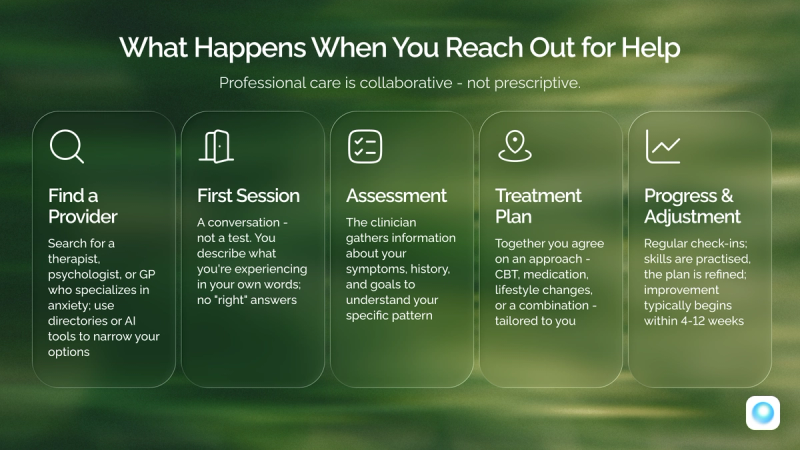
What to Expect: Your Path to Getting Help
For many people, the anxiety about seeking help for anxiety is itself a significant barrier. What will the first appointment be like? What will they ask? How long will it take? Will I have to take medication? Demystifying the process is often what makes it possible to take the first step.
Professional mental health care for anxiety is collaborative, not prescriptive. You will not be told what you must do — you will work with a clinician to develop a plan tailored to your specific symptoms, circumstances, and preferences.
Ready to Take Control? Get 24/7 Support Starting Right Now
You've learned what your symptoms mean — now find relief. Dzeny provides judgment-free guidance whenever you need it. No waiting, no appointments, just genuine support available around the clock.
Begin Your JourneyEffective Management Strategies: Finding Relief That Works
Effective anxiety management is not a single technique or a quick fix. It is an integrated practice that combines professional treatment where appropriate, evidence-based self-help strategies, lifestyle foundations that support a regulated nervous system, and the consistent effort to apply what you have learned even when it is difficult. Understanding this from the outset sets the right expectation: not that anxiety will disappear, but that it will become smaller, more predictable, and increasingly under your influence.
Professional Treatment Approaches That Work
Professional treatment for anxiety is effective. The research is not ambiguous on this point — 70–90% of people with anxiety disorders experience significant improvement with appropriate, evidence-based treatment.
Evidence-Based Professional Treatments
- Cognitive Behavioral Therapy (CBT) — the gold standard. Efficacy: 70–75% across anxiety disorders. Addresses the thought-feeling-behavior cycle.
- Exposure Therapy — highly effective for phobias, OCD, PTSD, and avoidance-based anxiety. Gradual systematic exposure in a safe context.
- Acceptance and Commitment Therapy (ACT) — teaches acceptance of anxious thoughts as mental events, not facts; focuses on values-based action.
- Medication: SSRIs and SNRIs (first-line) — 50–60% response rate, 4–6 weeks to full effect, non-addictive, best combined with therapy.
- Medication: Benzodiazepines — rapid relief for acute episodes; significant dependence risk with regular use; short-term only.
Self-Help Techniques You Can Start Today
The following four techniques are evidence-based, drawn directly from clinical practice, and can produce genuine relief when used consistently. They are not substitutes for professional treatment in severe cases — but they are the same core skills taught in CBT.
Box Breathing: Activating the Parasympathetic Nervous System
When to use: during acute anxiety, panic, or as a daily regulation practice. Why it works: slow, rhythmic breathing activates the vagus nerve, engaging the parasympathetic nervous system.
- Inhale slowly through the nose for 4 counts
- Hold for 4 counts
- Exhale slowly through the mouth for 4 counts
- Hold for 4 counts
Repeat 4–6 cycles. Results are noticeable within 2–3 minutes of consistent practice.
5-4-3-2-1 Grounding: Interrupting the Anxiety Spiral
When to use: during panic attacks, dissociation, or when anxious thoughts are spiraling. Why it works: directing attention to current sensory experience activates the prefrontal cortex and redirects neural resources away from the amygdala-driven threat response.
- 5 things you can see — name each one specifically
- 4 things you can physically feel — temperature, texture, pressure
- 3 things you can hear — identify each sound
- 2 things you can smell — even subtle background scents
- 1 thing you can taste — even just the inside of your mouth
Progressive Muscle Relaxation (PMR)
When to use: before sleep, during high-tension periods, or as a daily practice. How: tense each muscle group firmly for 5 seconds, release for 10 seconds. Progress: feet → calves → thighs → abdomen → chest → hands → arms → shoulders → face. One full cycle takes 15–20 minutes.
Thought Challenging: Working with Anxious Thinking
The four questions to ask when rumination or catastrophic thoughts dominate:
- What is the anxious thought, stated precisely?
- What is the evidence FOR this thought being accurate?
- What is the evidence AGAINST this thought, or for an alternative outcome?
- What is a more balanced, realistic perspective that accounts for all the evidence?
Important
The goal is not positive thinking — it is accurate thinking. 'Everything will be fine' is as distorted as catastrophizing. The goal is the most honest assessment available.
Lifestyle Changes That Make a Real Difference
Lifestyle factors are not peripheral to anxiety management — they are foundational. The nervous system does not operate in isolation from the body that houses it. Sleep deprivation, physical inactivity, excessive caffeine, social isolation, and nutritional patterns all directly influence the threshold at which anxiety activates and the intensity of its response.
| Lifestyle Factor | What the Evidence Shows and What to Do |
|---|---|
| Exercise | 30 minutes of moderate aerobic activity 3–5 times per week reduces anxiety symptoms by 20–30% through endorphin release, cortisol regulation, and nervous system downregulation. |
| Sleep | Sleep deprivation amplifies anxiety reactivity by 30%+. Consistent sleep schedule, cool dark room, no screens 1 hour before bed, and a brief wind-down ritual significantly improve sleep quality. |
| Caffeine | A physiological stimulant that mimics fight-or-flight activation. For anxiety-prone individuals, even moderate consumption can lower the threshold for anxiety episodes. Reduce to under 200mg/day. |
| Alcohol | Temporarily reduces anxiety but produces rebound anxiety as it metabolizes — often worse than the original. Regular use as coping creates tolerance and dependence. |
| Nutrition | Complex carbohydrates support steady serotonin production. Omega-3 fatty acids have anti-inflammatory and anxiolytic properties. Magnesium-rich foods (dark chocolate, avocado, leafy greens, nuts) help. |
| Social Connection | Isolation amplifies anxiety by removing perspective and reducing oxytocin. Quality over quantity: one genuine connection is worth more than many superficial ones. |
| Structure and Routine | Predictability reduces uncertainty. Consistent morning routine, regular mealtimes, structured evenings signal safety to the nervous system. |
How AI Support Can Help Your Anxiety Journey
The traditional mental health care system — while deeply valuable — has structural limitations that affect millions of people: long waiting lists, significant cost, limited availability outside business hours, geographic inaccessibility, and the stigma that still prevents many people from walking through a therapist's door for the first time. AI-powered mental health support does not replace clinical care, but it genuinely addresses several of these barriers in ways that are clinically meaningful.
AI tools like Dzeny provide immediate, accessible, judgment-free support grounded in evidence-based techniques — primarily Cognitive Behavioral Therapy, which is the same approach used by clinical psychologists treating anxiety. The value is not as a substitute for human clinical expertise in complex cases, but as a genuinely useful resource for the large and underserved population experiencing mild-to-moderate anxiety who currently have no support at all.
| What AI Support Offers | What AI Support Cannot Do |
|---|---|
| 24/7 availability — support during anxiety episodes at 3am, weekends, or whenever you need it | Cannot replace professional care for severe anxiety, trauma, or complex clinical presentations |
| Judgment-free space — people often share more with AI than with humans initially | Cannot prescribe medication or provide clinical diagnosis |
| Evidence-based guidance — CBT techniques, grounding exercises, psychoeducation delivered in real time | Not appropriate as a sole resource for emergency situations or suicidal ideation — contact 988 immediately |
| Immediate access — no waiting weeks for an appointment | Cannot form the therapeutic alliance that accounts for 30% of treatment outcomes in human therapy |
| Affordable and accessible — significantly lower barrier than traditional therapy | Best suited for mild-moderate symptoms or as a supplement to professional care, not a replacement |
| Practice space — test coping techniques, process anxious thoughts, prepare for therapy sessions | Encourages professional help when symptoms suggest clinical care is needed |
Living Well with Anxiety: Long-Term Outlook
Recovery from an anxiety disorder does not mean never feeling anxious again. It means developing the skills, understanding, and support network to manage anxiety effectively — so that it no longer runs your life. This is an important distinction, and embracing it changes both the goal and the experience of treatment.
The research on anxiety treatment outcomes is genuinely encouraging. Approximately 70–90% of people with anxiety disorders experience significant improvement with appropriate intervention. Noticeable improvement typically occurs within 4–12 weeks of consistent treatment engagement, with continued gains over months as skills are practiced and consolidated.
Factors That Predict Better Long-Term Outcomes
- Early intervention — addressing anxiety before avoidance patterns and impairment become deeply entrenched
- Consistent engagement with treatment — attending sessions, completing homework, practicing skills daily
- Addressing lifestyle foundations — sleep, exercise, nutrition, social connection, caffeine and alcohol
- Treating co-occurring conditions — depression, substance use, and medical conditions all affect anxiety
- Building a support system — people who know about your anxiety and can support your management efforts
- Self-compassion during setbacks — treating a difficult week as information, not failure
- Long-term maintenance perspective — using therapy for tune-ups during stressful periods, not just in crisis
Expert Tip — Recovery is not the absence of anxiety
It is the presence of a life you are actually living. The goal of treatment is not to eliminate every anxious feeling. Some anxiety is appropriate, useful, and universal. The goal is to reduce anxiety to a manageable, proportionate response — and to stop organizing your life around avoiding it. When that happens, the life that was being lost to avoidance gradually comes back.
If you want a clearer read on where your anxiety sits right now, our Free Anxiety Test takes a couple of minutes and needs no sign-up.
Conclusion: Your Path Forward Starts Here
If you have read this far, you have already done something important: you have sought understanding. Anxiety thrives in confusion and isolation. Knowledge — even imperfect, partial knowledge of what your symptoms mean and why they are happening — is the beginning of a different relationship with the experience.
Anxiety is not evidence that something is wrong with you. It is evidence that you have a nervous system that is trying, in the only way it knows, to protect you. The work of anxiety management is not fighting against yourself — it is learning to work with your own biology, to recognize the patterns, and to choose different responses gradually and with compassion.
Support is available. The path does not require you to have everything figured out before you start. It requires only the willingness to take the next step — whether that is a conversation with a trusted person, a first session with a therapist, an honest assessment of your lifestyle foundations, or simply using the techniques in this article the next time anxiety rises.
You do not have to wait until things get worse. The best time to reach for help is now — while your life is still largely intact, before avoidance has had time to consolidate. Help works. You are worth it.
Frequently Asked Questions

Written by
Valentina Lipskaya
Clinical Psychologist · Gestalt Therapist · CBT Specialist · ICF Certified Coach · MBA Professor
Panic Disorder, Anxiety, CBT & Gestalt Therapy
Valentina Lipskaya is a certified clinical psychologist and gestalt therapist specializing in panic disorders, anxiety, and neurological conditions. With over 15 years in psychology and 7 years of hands-on clinical practice, she has helped more than 750+ clients overcome panic, chronic anxiety, and psychosomatic conditions — without medication. Her work at Dzeny translates evidence-based therapeutic methods into practical, accessible guidance for everyday mental health.