

Decision Fatigue: Why Your Brain Gives Up Before Bedtime
Why your choices get worse as the day goes on, and why it shows up first in the smallest ones.
In this article
What is actually happening when you cannot choose
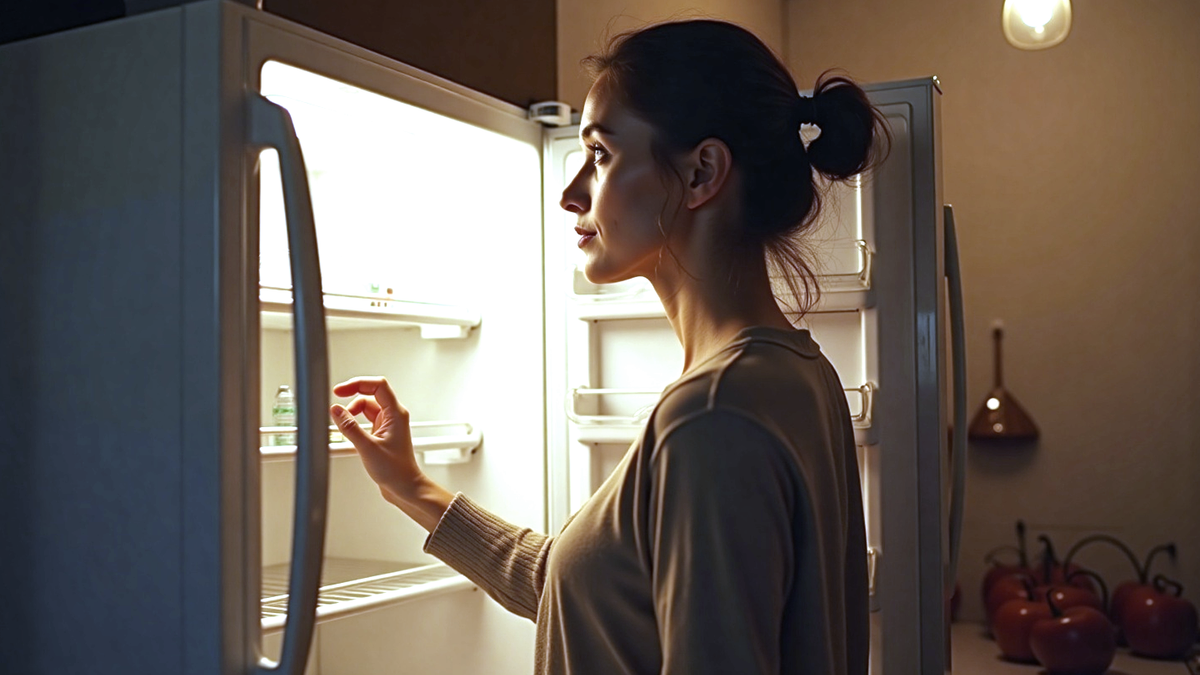
It is seven in the evening. You are standing in front of the open fridge, staring at the same shelves you have looked at a hundred times before. Nothing looks right, nothing sounds appealing, and you close the door without taking anything. Twenty minutes later you are back. You still cannot decide.
This is not about hunger, and it is not laziness. What you are experiencing has a name: decision fatigue. And once you understand the mechanism behind it, the staring-into-the-fridge moment stops feeling like a personal failing.
Every single choice you make — whether to answer that message now or later, which route to take to work, whether to have the salad or the soup, whether to push back on a colleague's comment or let it go — draws on a shared cognitive resource. Research in self-regulation describes this as a finite pool of mental energy dedicated to deliberate, effortful thinking. The pool replenishes with rest. Throughout the day, it depletes. By the time evening arrives, the reservoir is low, and your brain begins to take shortcuts: it defaults to whatever is easiest, avoids choosing altogether, or selects impulsively just to end the discomfort of deciding.
Why evenings hit hardest, and why small things trip you up
Closely related: high Functioning Depression and why Your Mind Serves Up Disturbing Thoughts.
Most of us assume that big decisions are the ones that exhaust us. In practice, the opposite pattern is just as significant. It is the sheer volume of small choices that accumulates. What to say in a reply email. Whether to mention something to a friend. Which streaming service to open. None of these feels taxing in isolation. Together, they are relentless.
By evening, the brain is not simply tired — it is specifically depleted in its capacity for deliberation. This is why the arguments that break out after eight o'clock so often start over something trivial. You snap at someone over a tone of voice, or over which takeaway to order, or because they left a cupboard open. The disproportionate reaction is not a character flaw. It is a system under stress expressing itself through the nearest available release valve.
There is also a predictable quality decline in the choices people make later in the day. Studies on judicial decisions, medical recommendations, and consumer choices have consistently shown that people become more likely to choose the status quo, approve the default option, or select whatever requires the least cognitive work as the day progresses. This is not a story about willpower in the old-fashioned sense of trying harder. It is a story about cognitive architecture, and it applies to everyone.
How this differs from ordinary tiredness and from burnout
These three things — fatigue, decision fatigue, and burnout — overlap and interact, but they are not the same experience, and it matters to distinguish them.
Ordinary tiredness is physical and recoverable. A good night's sleep reliably clears it. You feel sluggish, your reaction time slows, but your relationship with your own life does not feel fundamentally broken.
Decision fatigue is specifically cognitive and accumulates within a single day. It is reset, or at least significantly reduced, by sleep and by deliberate breaks. You may not feel physically tired at all — someone can be well-rested and still experience the fridge-staring phenomenon after a day packed with back-to-back choices. The signature is that your thinking feels specifically cloudy, commitment feels effortful, and avoidance becomes appealing.
Burnout is a much longer-arc experience. It develops over weeks and months of sustained overload without adequate recovery. It carries emotional exhaustion, growing detachment or cynicism, and a reduced sense of competence that does not resolve after a single night's sleep or a long weekend. If decision fatigue is a depleted battery, burnout is a battery that has been cycled through depletion so many times that it no longer holds its full charge. If you recognise yourself in that description, working with a mental health professional is worth considering — this article is about the everyday version, not that longer story.
What it looks like when it is happening to you
The observable signs are mundane and easy to dismiss:
- Rereading the same message several times without being able to form a reply, not because the message is complicated but because choosing a tone feels impossible.
- Defaulting to whatever is easiest — the most familiar meal, the first option on a list, saying yes to something you did not want to agree to simply to avoid the friction of negotiating.
- Avoidance that feels like deliberation. You tell yourself you are thinking it over, but what you are actually doing is postponing the discomfort of committing to an answer.
- Irritability over minor things — snapping at a partner, losing patience with a child who asks a simple question, feeling a disproportionate surge of frustration at something small.
- Analysis paralysis on low-stakes choices. Spending ten minutes on a restaurant menu for a casual weeknight dinner is not careful decision-making; it is a depleted system struggling to execute a routine task.
If you want a clearer read on where your anxiety sits right now, our Free Anxiety Test takes a couple of minutes and needs no sign-up.
What actually helps: concrete steps
These are not life overhaul suggestions. They are specific adjustments that reduce the load your cognitive system has to carry.
Reduce the number of open choices. A choice that is already made does not cost you anything in the moment. Decide on five or six meals you rotate through during the working week and stop treating dinner as a daily creative problem. Choose your gym days in advance and make them fixed rather than something you negotiate with yourself each morning. Every recurring decision you settle once is a decision that stops drawing from the daily reserve.
Decide once instead of daily. This principle applies wherever you notice yourself repeating the same deliberation. When to check email, whether to exercise, what to wear on weekday mornings — these can all become policies rather than questions. A policy removes the choice from the daily stack entirely.
Batch the decisions that require real thought. If you have meaningful choices to make — career-related, relationship-related, financial — protect your morning hours for them. Cognitive capacity is at its highest in the first part of the day for most people. Scheduling a difficult conversation for nine in the morning is not dramatic; it is just accurate resource management.
Build deliberate pauses before the depletion becomes acute. A ten-minute break without a screen, particularly a break that involves physical movement or simply looking out of a window, is not indulgent. It gives the prefrontal cortex — the part most heavily involved in deliberate choice — a brief recovery window. You do not need to meditate; you need to stop making decisions for a few minutes.
Protect your evenings from high-stakes decisions. Not because you are incompetent in the evenings, but because the quality of your choices there is reliably lower. If something genuinely matters, give it your morning.
References
- 1.Baumeister, R. F., Bratslavsky, E., Muraven, M., & Tice, D. M.. Ego depletion: Is the active self a limited resource? *Journal of Personality and Social Psychology*, 1998 (1998)
- 2.Danziger, S., Levav, J., & Avnaim-Pesso, L.. Extraneous factors in judicial decisions. *Proceedings of the National Academy of Sciences*, 2011 (2011)
- 3.Hagger, M. S., et al.. A multilab preregistered replication of the ego-depletion effect. *Perspectives on Psychological Science*, 2016 (2016)
- 4.World Health Organization. Burn-out an "occupational phenomenon": International Classification of Diseases, 2019 (2019)
Frequently Asked Questions

Written by
Valentina Lipskaya
Clinical Psychologist · Gestalt Therapist · CBT Specialist · ICF Certified Coach · MBA Professor
Panic Disorder, Anxiety, CBT & Gestalt Therapy
Valentina Lipskaya is a certified clinical psychologist and gestalt therapist specializing in panic disorders, anxiety, and neurological conditions. With over 15 years in psychology and 7 years of hands-on clinical practice, she has helped more than 750+ clients overcome panic, chronic anxiety, and psychosomatic conditions — without medication. Her work at Dzeny translates evidence-based therapeutic methods into practical, accessible guidance for everyday mental health.