

Video Game Addiction: When Gaming Becomes a Problem — and When It Doesn't
Gaming disorder is a real diagnosis with three criteria and a twelve-month clock - and most heavy gaming is not it. How to tell the difference, and what actually helps.
In this article
What we're actually talking about
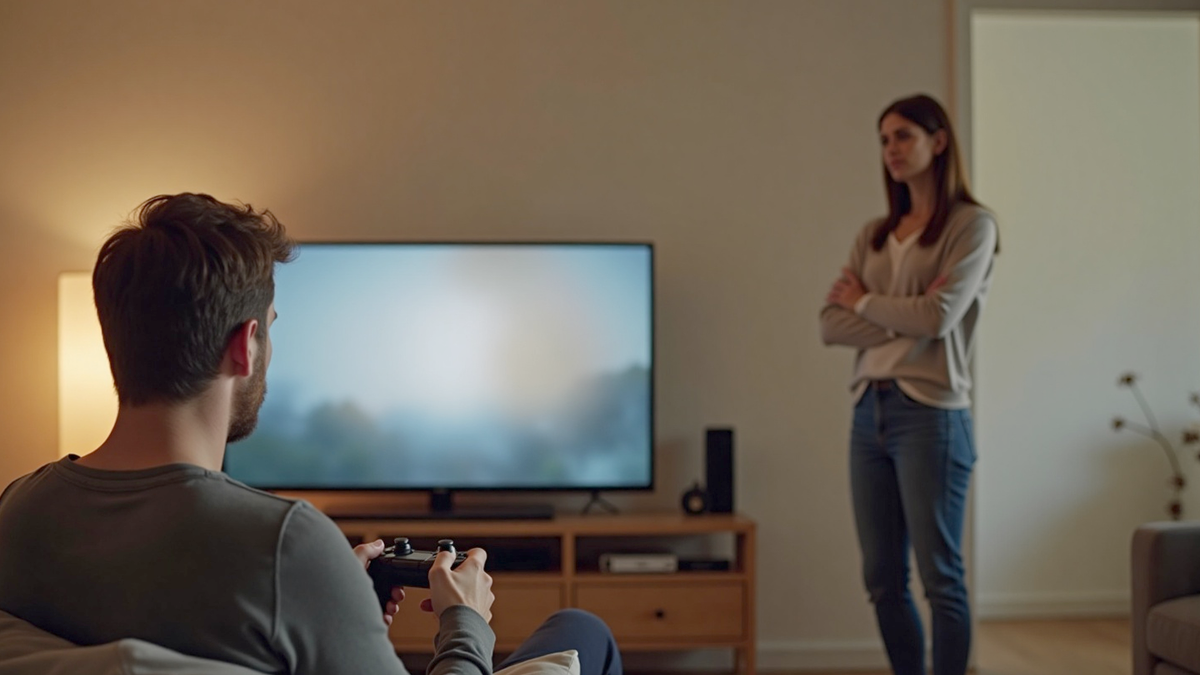
I'm a clinical psychologist. I work with people who are struggling, and over the last few years I've noticed that gaming comes up in a way it didn't a decade ago — not always as the main problem, but often as something circling around it. A parent convinced their son is addicted. A partner who feels invisible. A young man who knows something has shifted but can't quite name it.
What I want to do in this piece is give you something more useful than alarm or reassurance. I want to give you the actual clinical picture, the honest numbers, and the steps that the evidence says help. With GTA 6 launching on 19 November 2026, this question is landing in a lot of households at once, and it deserves a careful answer.
What gaming disorder actually is — and what it isn't
Closely related: anxiety and Panic Attacks and gTA 6 Launches on 19 November.
The World Health Organisation's ICD-11 lists gaming disorder under code 6C51, with two subtypes: 6C51.0 for predominantly online gaming and 6C51.1 for predominantly offline. The definition requires all three of the following features, together, not one or two:
1. Impaired control over gaming. This means difficulty regulating when you start, how long you go on, how intensely you play, when you stop, and in what contexts gaming happens. An observable example: you sit down intending to play for a short while before dinner, and two hours later dinner is cold and you genuinely don't know where the time went — and this is the pattern, not the exception.
2. Gaming taking increasing priority over other life interests and daily activities. The keyword is *increasing*. An observable example: you used to go to the gym on Thursdays and see a friend on Saturdays. Over six months, both quietly disappeared, not because life changed, but because gaming filled the space first. This matters because it shows a gradual reorganisation of life around the game.
3. Continuation or escalation despite negative consequences. An observable example: you've had a serious conversation with your partner about how absent you feel, you agreed to change, and within two weeks the pattern is back — not because you didn't mean it, but because stopping is harder than it looked from the outside.
The ICD-11 requires that this pattern be evident for at least 12 months, though the period may be shortened if all three criteria are met and symptoms are severe.
I want to be explicit about something the definition itself is explicit about: hours played are not a criterion anywhere in this definition. A person can play for many hours a week and not meet any of these three features. A person can play for fewer hours and meet all of them. If your first instinct is to count the hours, I understand why — it feels measurable — but the hours are not what the research or the clinical framework is measuring.
The honest numbers
Prevalence figures for gaming disorder are quoted everywhere and they vary wildly. The most methodologically careful estimate I can point you to is a 2021 pooled analysis by Stevens and colleagues, published in the *Australian and New Zealand Journal of Psychiatry*, which combined 53 studies covering 226,247 participants across 17 countries. They found a worldwide prevalence of 3.05% (confidence interval 2.38% to 3.91%) — falling to 1.96% when only studies meeting stricter sampling criteria were included, though that stricter figure came with a confidence interval so wide (0.19% to 17.12%) that it is better read as a warning about the evidence than as a number. The ratio was approximately 2.5 men to every 1 woman.
Here is the part that matters most for reading any headline figure: the choice of screening questionnaire explained 77% of the variance between studies. In plain English, most of the difference between a study reporting 1% prevalence and one reporting 10% is the questionnaire they used, not a real difference in how many people are struggling. The numbers most people quote are inflated by how they were measured. That doesn't mean gaming disorder isn't real. It means the field is still sorting out how to count it, and scepticism about any single figure is warranted.
Heavy gaming versus the three ICD-11 features: a practical guide
| Pattern | What it looks like day to day | What to do about it |
|---|---|---|
| Heavy gaming, no disorder | Long sessions, strong preference for gaming, occasional late nights, but work, relationships and health are maintained | Nothing clinical; personal reflection on balance is enough |
| Impaired control (Feature 1) | Consistent inability to stop at an intended time; sessions regularly override planned activities | Track start and stop times for two weeks; note the gap between intention and reality |
| Priority shift (Feature 2) | Hobbies, friendships or responsibilities have quietly dropped away over months | List what you did six months ago that you no longer do; ask whether gaming filled that space |
| Continuation despite harm (Feature 3) | Serious consequences — relationship strain, job risk, physical health — that haven't changed the pattern | This is the signal that self-management alone is unlikely to be enough; professional support is worth seeking |
What the evidence says helps
Two recent meta-analyses give us a clearer picture than we had five years ago, and they are worth looking at honestly — both the strong and the weak parts.
Stevens and colleagues, writing in *Clinical Psychology and Psychotherapy* in 2019, conducted a meta-analysis of cognitive behavioural therapy for internet gaming disorder and found large effects on gaming symptoms (Hedges' g = 0.92) and depression (g = 0.80), and a moderate effect on anxiety (g = 0.55) immediately after treatment. Those are meaningful numbers. But the gains were not significant at follow-up, and the effect on the number of hours actually played was unclear. CBT appears to reduce distress and help people regain control; it doesn't straightforwardly reduce gaming time, and the benefits need to be maintained actively.
A more recent meta-analysis by Byeon, published in the *World Journal of Psychiatry* in 2025, looked at 11 randomised controlled trials with 1,208 participants and found that non-invasive interventions reduced symptoms overall (g = 0.56, 95% CI 0.38–0.74). CBT — delivered in person or online — was the strongest approach, particularly when combined with self-monitoring or family involvement. Family therapy specifically reduced the number of diagnostic criteria met in adolescents.
The signal from both studies is consistent: the psychological mechanism matters more than the hours. CBT works on what the game is doing *for* you, not simply on the time you spend in it.
The motive matters more than the hour count
If you take one research finding from this piece, take this one. A 2026 systematic review and meta-analysis by Kiszka and colleagues in the *Journal of Behavioral Addictions* pooled 119 studies covering 119,730 people and looked at why people play. The escapism motive — playing to get away from something — was associated with gaming disorder at r = 0.51 and with negative affect at r = 0.51, with moderate associations to depression, anxiety, stress, loneliness and difficulties in emotion regulation, while self-esteem and life satisfaction ran the other way. The motives that look like enjoyment — flow, a sense of competence, autonomy, connection with other players — showed no significant association with problems at all.
These are cross-sectional correlations and cannot tell us which came first; distress may drive the escaping as easily as the other way round. But they point at the right question. Two people can play the same forty hours a month, and the difference that matters is whether the game is somewhere they go towards or somewhere they go away from.
A practical starting point: the question before you open the game
The most useful self-monitoring step I can offer is this: before you open the game, write down in one line why you're opening it right now. Not a judgment — just a note. Bored. Dreading a conversation. Winding down after a fight. Avoiding something I'm supposed to do. This is the material CBT works on. The game is doing something. Once you can see what it's doing, you have choices. Without that, you're trying to stop a behaviour without understanding its function, and that almost never works long-term.
If you're worried about someone else
If your partner or your adult son is gaming in a way that worries you, start from what the definition is actually made of. A conversation built around the number of hours argues about the one thing that is not a criterion, and in my experience it reliably produces defensiveness rather than change. The trials have not tested confrontation against anything, so I am not going to dress my clinical experience up as evidence — but what they have tested, and what they support, is family involvement in a plan — not an ultimatum, but a genuine shared conversation about what life looked like before, what's changed, and what support might look like. Byeon's 2025 findings on family therapy reducing diagnostic criteria in adolescents point in this direction. The goal is not to get the person to play less; it's to help them re-engage with the parts of life that have been crowded out.
When you want to talk it through
If any of this has landed and you'd like to work through it with someone — whether you're the person gaming or someone living alongside it — Dzeny is available around the clock for exactly that conversation.
References
- 1.Stevens MW, Dorstyn D, Delfabbro PH, King DL. Global prevalence of gaming disorder: A systematic review and meta-analysis, *Australian and New Zealand Journal of Psychiatry*, 2021;55(6):553-568 (2021)
- 2.Stevens MW, King DL, Dorstyn D, Delfabbro PH. Cognitive-behavioral therapy for Internet gaming disorder: A systematic review and meta-analysis, *Clinical Psychology and Psychotherapy*, 2019;26(2):191-203 (2019)
- 3.Kiszka P, Strojny A, Strojny P. Escapism in gaming: A comprehensive systematic review and meta-analysis, *Journal of Behavioral Addictions*, 2026 (2026)
- 4.Byeon H. Effectiveness of non-invasive interventions for internet gaming disorder: A meta-analysis of randomized controlled trials, *World Journal of Psychiatry*, 2025 (2025)
- 5.World Health Organization. Gaming disorder: questions and answers on the ICD-11 classification (6C51), 2020 (2020)
Frequently Asked Questions

Written by
Valentina Lipskaya
Clinical Psychologist · Gestalt Therapist · CBT Specialist · ICF Certified Coach · MBA Professor
Panic Disorder, Anxiety, CBT & Gestalt Therapy
Valentina Lipskaya is a certified clinical psychologist and gestalt therapist specializing in panic disorders, anxiety, and neurological conditions. With over 15 years in psychology and 7 years of hands-on clinical practice, she has helped more than 750+ clients overcome panic, chronic anxiety, and psychosomatic conditions — without medication. Her work at Dzeny translates evidence-based therapeutic methods into practical, accessible guidance for everyday mental health.