

Crush on a Coworker? The Psychology of Office Romance, and What to Do Next
A crush on a coworker is not a lapse in professionalism or proof of destiny. A clinical psychologist explains why attraction grows at work, what 1,073 workers told SHRM about office romance, and how to decide what to do next.

In this article
You did not plan it. You noticed that you check who is already in the kitchen before you go for coffee, that a Monday feels lighter when a certain person is in the office, and that you reread one message three times before replying. Somewhere between a shared deadline and a joke nobody else got, a colleague became the best part of your working day.
I am a clinical psychologist, and I hear this story more often than people expect. A crush on a coworker is not a lapse in professionalism, and it is not proof of destiny either. It is a predictable result of how human attachment works, placed inside a setting with rules, hierarchy and a shared calendar. Below is what is actually going on, and how to decide what to do with it. If you are trying to make sense of your feelings more broadly, the relationships section is a good place to start.
Why it happens at work and not on the apps
Psychologists noticed the pattern long before open-plan offices. In a classic study of a student housing complex, Leon Festinger and his colleagues found that the strongest predictor of who became friends was simply who lived closest to whom. Not shared values or interests, but the distance between the doors.
In 1968 Robert Zajonc described the mechanism behind it: the mere exposure effect. The more often we encounter something, the more we tend to like it, even when nothing else changes. Later it was tested on people directly. In one well-known classroom study, women who quietly attended a lecture course more often were rated as more attractive and more likeable by the other students, although they never spoke to anyone.
Now look at an ordinary office through that lens. You see the same people every day. You solve problems together, you are stressed about the same things, you witness each other being competent, tired and funny. Work does a large part of what dating apps try to fake: repeated contact, a shared context and a gradual reveal of who someone is. Research on workplace romance names exactly these ingredients, proximity, repeated exposure and working closely towards a common goal, as the soil where attraction grows.
So if you have developed feelings for a colleague, the first useful thought is this: nothing is wrong with you. The setting was almost designed for it.
What people who have been there report
In January 2024 SHRM, the largest HR association in the US, surveyed 1,073 American workers about romance at work. A few of the findings are worth knowing before you decide anything:
- Among people currently in a workplace relationship, 85% said it had a positive effect on their mood at work, 83% on their motivation, and 81% on their commitment to the organisation.
- Of those whose office romance was in the past, nearly three quarters (74%) said it was worth it.
- At the same time, 1 in 10 left a job they otherwise liked because the relationship ended, and 22% stayed in a job they disliked longer than they normally would have.
- 34% of workers said they have a "work spouse", and 43% of them admitted to having actual feelings for that person.
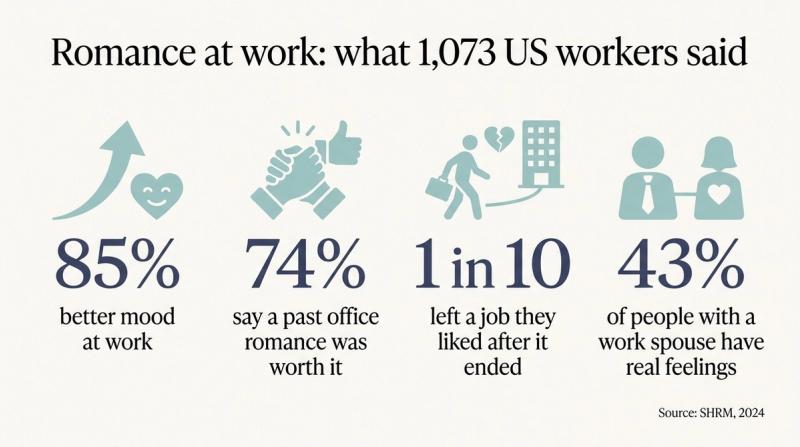
The picture is not "office romance is good" or "office romance is a disaster". It is that the stakes are higher than in an ordinary relationship, because the job becomes part of it, in both directions.
Is it the person, or what the job does to you?
Before acting on a crush, it helps to check what exactly you are attracted to. At work we see people in a very particular light.
You may be drawn to competence. Someone who stays calm in a crisis, explains things clearly or defends you in a meeting is showing qualities that are genuinely attractive. But you are seeing their best professional self, and very little of how they behave at home, with money, or in a conflict that does not have a deadline.
You may be drawn to relief. If your work is stressful and one person makes it bearable, the feeling of safety around them can be easily mistaken for romantic interest. Ask yourself whether the feeling would survive outside the building.
You may be drawn to uncertainty. Mixed signals, a warm conversation followed by a week of distance, are a powerful hook. Unpredictable attention keeps the mind busy far more than steady attention does. If the crush mostly consists of analysing their messages, that is often anxiety rather than love. I have written about how overthinking takes over in relationships, and the mechanism is the same here.
None of this means the feeling is not real. It means it is worth knowing which part of it belongs to the person and which part belongs to the situation.
If you are both single: questions to ask before you act
A crush between two available adults is not a problem in itself. What makes the difference is how it is handled.
Is there a power difference? If one of you manages the other, influences their pay, projects or promotion, the relationship is not between equals at work, however equal it feels privately. This is where office romance most often turns into a real risk, for both people and for the team around them.
What does your company actually say? In the same SHRM survey, 64% of workers said organisations should not ban workplace romance, but 78% wanted clear guidelines. Read your policy before, not after. Some companies require disclosure, especially within a reporting line.
Can you both survive a "no"? Ask yourself honestly whether you could keep working calmly with this person if they are not interested. If the answer is no, slow down. A short conversation outside work, without pressure and with an easy way out, is kinder to both of you than a dramatic confession.
Can you survive an ending? Statistically, many relationships end, and at work the ex does not disappear. In the SHRM survey, 62% of people kept working with their ex after the relationship was over.
If you tend to feel anxious at the start of anything romantic, it may help to read about new relationship anxiety, or to take our attachment style quiz to see how your patterns show up when someone matters to you.
If you are in a relationship: the "work spouse" question
This is the part people rarely say out loud. You love your partner, nothing happened, and yet you notice that you share your day with a colleague first, that you look forward to their reaction more than to the conversation at home.
A close friendship at work is not a betrayal. But it is worth watching where your emotional energy goes. Some signs that a work friendship has started to take something from your relationship:
- you tell the colleague about problems at home that your partner does not know you have discussed;
- you would feel uncomfortable if your partner read your conversations, even though nothing explicit is in them;
- you find yourself comparing your partner with this person;
- news, good or bad, goes to the colleague first.
If several of these are true, the question is not "am I a bad person". The question is what is missing in your relationship right now, and whether you can bring it back there. Feelings for someone else often point to a need, attention, admiration, playfulness, that has gone quiet at home. That need deserves a conversation with your partner, not a secret. If the topic is already painful in your couple, our guide on feeling insecure in a relationship covers how to talk about it without accusations.
If the crush is one-sided: how to get over a crush on a coworker
Sometimes the answer is clear: they are not available, not interested, or you know that acting on it would cost too much. You still have to see them every day. A few things help:
Name it to yourself, plainly. "I have a crush on X, and I have decided not to act on it" is calmer than a feeling you keep arguing with. Fighting a feeling usually makes it louder.
Reduce the fuel, not the person. You cannot avoid a colleague, but you can stop the extra contact you create: rereading their messages, checking their status, finding reasons to pass their desk. Mere exposure works in both directions, less unnecessary contact gradually weakens the pull.
Invest outside work. A crush often grows where the rest of life is thin. Friends, a hobby, a plan for the weekend give your attention somewhere else to land.
Watch the story, not just the feeling. If your mind keeps building scenarios, "maybe they feel the same, maybe that look meant something", write them down and look at them the next morning. Fantasies are much less convincing on paper.
Give it time. For many people the intensity fades once it is no longer fed. If it does not, and it starts affecting your sleep, your work or your relationship, that is a reason to talk to someone.
If it ended and you still sit next to them
The hardest version of office romance is the one that is over. You see the person at stand-ups, in the kitchen, in a group chat. Every encounter reopens it a little.
Treat it like a breakup with extra exposure. Agree on basic rules if you can: how you behave in meetings, what you tell colleagues, what you do not discuss at work. Keep conversations to work for a while, even if you want to be friends eventually. And be honest with yourself about whether staying in this job is still your choice, or whether you are staying, or leaving, only because of them. Remember the 1 in 10 who left a job they liked: sometimes that is right, but it should be a decision, not an escape. Our article on anxiety after a breakup describes what the first weeks usually feel like and what helps.
The honest version
Office romance is neither a scandal nor a fairy tale. It is what happens when people spend a large part of their lives next to each other, under pressure, working towards the same goal.
What matters is not whether you feel something, you will feel what you feel, but whether you understand it before it starts making decisions for you: about your career, your relationship, or your next nine to six. Healthy teams can handle this kind of human complexity, and it is easier when the culture around it is psychologically safe rather than secretive.
If you keep replaying the same conversation in your head, it often helps to say it out loud to someone neutral first.

⚠️ Important
This article is for information and support. It is not therapy, not a diagnosis and not a substitute for professional help. If you are in crisis, contact your local emergency number.
📲 Get the Dzeny app — an AI psychologist you can talk to about the feeling before it turns into a decision.
Written by Valentina Lipskaya, clinical psychologist, founder of Dzeny.
References
- 1.SHRM. New SHRM Research Shows Workplace Relationships Contribute to Positive Work Experiences (survey of 1,073 US workers, January 3–4, 2024) (2024)
- 2.Zajonc, R. B. Attitudinal effects of mere exposure. Journal of Personality and Social Psychology, 9(2, Pt. 2), 1–27 (1968)
- 3.Moreland, R. L., & Beach, S. R. Exposure effects in the classroom: The development of affinity among students. Journal of Experimental Social Psychology, 28(3), 255–276 (1992)
- 4.Festinger, L., Schachter, S., & Back, K. Social Pressures in Informal Groups: A Study of Human Factors in Housing. Harper (1950)
- 5.Pierce, C. A., Byrne, D., & Aguinis, H. Attraction in organizations: A model of workplace romance. Journal of Organizational Behavior, 17(1), 5–32 (1996)

Written by
Valentina Lipskaya
Clinical Psychologist · Gestalt Therapist · CBT Specialist · ICF Certified Coach · MBA Professor
Panic Disorder, Anxiety, CBT & Gestalt Therapy
Valentina Lipskaya is a certified clinical psychologist and gestalt therapist specializing in panic disorders, anxiety, and neurological conditions. With over 15 years in psychology and 7 years of hands-on clinical practice, she has helped more than 750+ clients overcome panic, chronic anxiety, and psychosomatic conditions — without medication. Her work at Dzeny translates evidence-based therapeutic methods into practical, accessible guidance for everyday mental health.