

"I Hate Myself": Why You Feel This Way and How to Start Being Kinder to You
Why you might hate yourself — and how self-compassion and CBT can quiet the inner critic.

In this article
If you've typed "I hate myself" into a search bar, first: take a breath. The fact that you reached out, even to a screen, means part of you is still looking for a way through. That part matters. You are not broken, weak, or beyond help for feeling this way, even if it feels enormous right now.
This article is a gentle place to land. We'll look at what "I hate myself" actually is (spoiler: it's a voice, not a verdict), why it shows up, how to tell the difference between self-hatred and depression, and specific, kind, evidence-based ways to start softening it. There's no lecture here and nothing to earn.
Here's the first reframe, and please hold onto it: self-hatred is a learned pattern, not the truth about who you are. Nobody is born hating themselves. Somewhere along the way, you absorbed a way of talking to yourself that has stayed long past its welcome. Patterns that were learned can be unlearned, slowly and with a lot of compassion.
Key takeaways
"I hate myself" is a learned inner voice, not a fact about your worth — and voices that were learned can be softened. It often traces back to early messages, trauma, comparison, or depression, and it can be gently unwound with self-compassion, CBT, and small caring actions. If the feeling comes with hopelessness or thoughts of self-harm, that's a signal to reach out to a professional or a crisis line right away.
What "I Hate Myself" Really Is
When you say "I hate myself," it feels like a fact you've discovered about your own worth. But look a little closer and you'll notice it's usually a *voice* — a running commentary that judges, blames, and predicts the worst. Psychologists often call this the inner critic.
The inner critic, not the truth
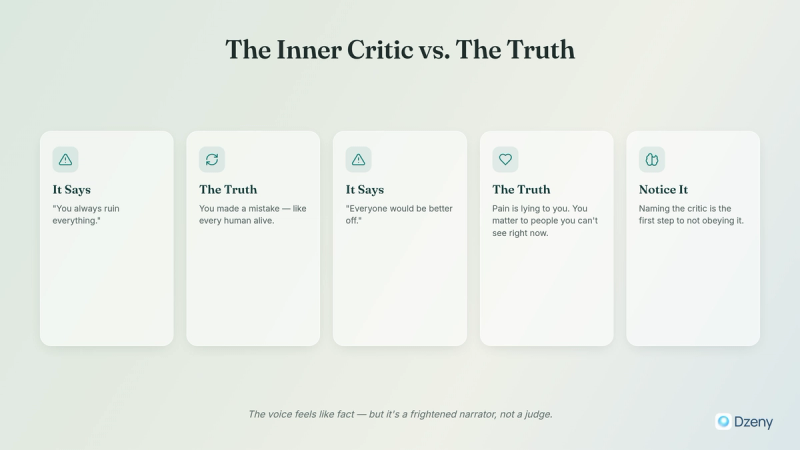
The inner critic speaks in absolutes: *always, never, everyone, nothing, worthless, disgusting.* It doesn't offer evidence, it just declares. And because it lives inside your own head, in your own voice, it borrows your credibility. That's the trap. The voice sounds like you, so you assume it must be telling the truth about you.
It isn't. A thought is not a fact. "I hate myself" is a thought your mind produces, often on autopilot, especially when you're tired, ashamed, or hurting. You can learn to hear that voice and, over time, stop treating it as the final word.
Why You Might Feel This Way
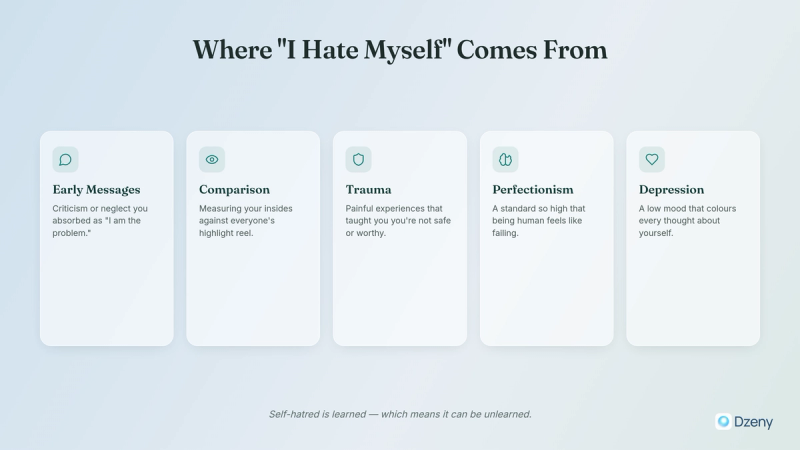
Self-hatred rarely comes from nowhere, even when it feels like it does. Usually there are threads leading back to something. You don't have to trace all of them to feel better, but understanding a few can loosen the grip of shame.
Childhood and early messages
The way you speak to yourself now is often an echo of how you were spoken *to* early on. If you grew up with criticism, high pressure, conditional love, or a caregiver who was hard to please, you may have internalized the idea that you're only acceptable when you're achieving, pleasing, or hiding parts of yourself. A child can't reason "my parent is struggling" — so they conclude "something is wrong with me." That conclusion can quietly run the show decades later.
Trauma and painful experiences
Bullying, abuse, rejection, or betrayal can leave you feeling fundamentally flawed. When something hurts us deeply, the mind sometimes turns the pain inward, deciding *I must have deserved it.* This is a protective mistake, not a truth. Blaming yourself can feel safer than accepting that you were hurt by something outside your control.
Comparison and perfectionism
Constant comparison, especially in a scrolling, filtered world, teaches you to measure your insides against everyone else's highlight reel. Perfectionism raises the bar so high that you're always falling short of it, and each shortfall becomes "proof" you're not enough. If this resonates, you might recognize yourself in imposter syndrome or the roots of low self-esteem.
Depression
Sometimes self-hatred is a symptom of depression rather than a standalone problem. Depression lies. It paints everything, including you, in the darkest possible color, and it makes those thoughts feel undeniably true. We'll look at how to tell the difference next.
Not sure where all this self-criticism is coming from?
Dzeny is an AI companion built on CBT principles that can help you gently trace a harsh thought back to its root and name what you're actually feeling — privately, at your own pace, with no judgment.
Talk to DzenyNo sign-up or card needed
The Difference Between Self-Hatred and Depression
These two overlap, but they're not the same, and knowing which you're dealing with helps you find the right support.
When it's more than a harsh inner voice
Self-hatred is primarily about *how you relate to yourself* — the critical voice, the shame, the feeling of not being good enough. It can exist even on otherwise okay days.
Depression is broader. It tends to come with persistent low mood, loss of interest in things you used to enjoy, changes in sleep and appetite, exhaustion, difficulty concentrating, and a heavy hopelessness that colors everything. Self-hatred is often one loud passenger in the car of depression.
Here's the gentle, important part: if the self-hatred comes with hopelessness that won't lift, or with thoughts of not wanting to be here, please treat that as a signal to reach out to a professional or a crisis line. You are worth that support.
When to reach out for help now
If you're having thoughts of harming yourself, please reach out immediately — you don't have to sit with this alone. In the US, call or text 988 (Suicide & Crisis Lifeline), available free and confidentially, 24/7. Outside the US, contact your local emergency services or crisis line. This article is a place to start, but it isn't a substitute for professional care.
How the Inner Critic Works and Where It Came From
The inner critic isn't your enemy, strange as that sounds. It usually started as a protector. Somewhere back, being hard on yourself may have kept you safe: if you criticized yourself first, maybe you could avoid rejection, meet impossible expectations, or brace for the worst before it arrived.
A misguided bodyguard
Think of the critic as an anxious bodyguard who never got the memo that the danger has passed. It's still shouting warnings, still trying to whip you into a shape it thinks will keep you loved and accepted. Its methods are cruel, but its original job was protection. This reframe matters because you don't have to *fight* the critic so much as understand it, thank it for trying, and gently update it.
The Physical and Behavioral Signs
Self-hatred doesn't only live in your thoughts. It shows up in the body and in how you treat yourself day to day. You might notice:
- A tight chest, a sinking stomach, or a wave of heat when you make a mistake
- Difficulty accepting compliments, or instantly deflecting them
- Apologizing constantly, even for existing
- Neglecting basic care — skipping meals, poor sleep, avoiding the doctor
- Staying in situations or relationships that confirm the story that you don't deserve better
- Harsh self-talk after small slip-ups, wildly out of proportion to what happened
- Isolating, because you assume people would be better off without you
Reading this list can bring a lump to your throat. If it does, notice how much you've been carrying, mostly alone. That's not weakness. That's a load no one should have to hold silently.
Why It Feels So True (and Why It Isn't)
Self-hatred is convincing for a few very human reasons. Your brain has a negativity bias — it clings to the critical and shrugs off the kind, so a hundred neutral moments vanish while one embarrassing memory replays for years.
There's also confirmation bias: once you believe "I'm worthless," your mind quietly collects evidence that fits and discards everything that doesn't. Someone doesn't text back? Proof. You did something well? A fluke, or luck. The belief becomes a lens, and everything you see through it looks the same color.
And because the critic speaks in your own voice, it feels like insight rather than distortion. But repetition isn't accuracy. A lie repeated a thousand times is still a lie — it just feels familiar. The familiarity is what you're feeling, not the truth.
Gentle, Evidence-Based Ways to Soften It
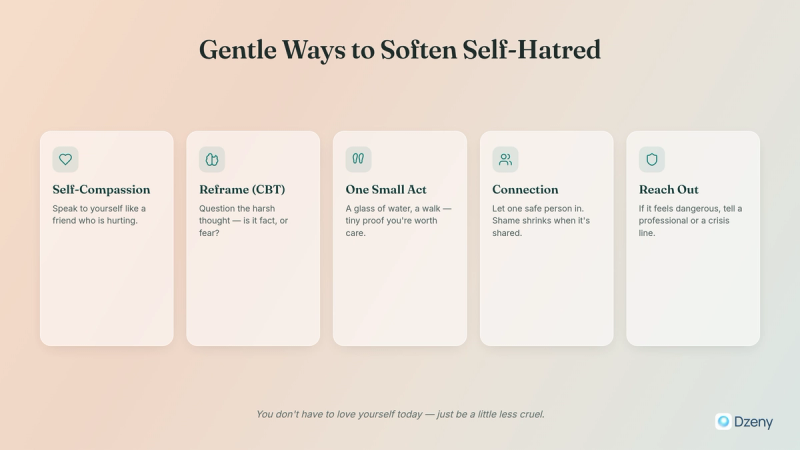
You don't have to leap from "I hate myself" to "I love myself." That gap is too wide and honestly, chasing it can add pressure. The goal is smaller and kinder: a little less cruelty, a little more neutrality, one softer sentence at a time.
Practice self-compassion
Research by psychologist Kristin Neff shows that self-compassion — treating yourself with the warmth you'd offer a good friend — is more powerful for wellbeing than self-esteem, and it doesn't depend on succeeding at anything. Try this: when the critic flares, ask, *what would I say to someone I love who felt this way?* Then offer yourself even ten percent of that kindness. It'll feel awkward. Do it anyway.
Talk back with CBT
Cognitive behavioral therapy (CBT) works with a simple, teachable idea: thoughts aren't facts, and you can examine them. When "I hate myself" shows up, try naming it — *ah, there's the critic* — and then gently questioning it: *Is this 100% true? What would I say to a friend? What's a more balanced thought?* You're not forcing false positivity. You're trading an absolute for something more accurate and fair. If harsh, automatic thoughts are a constant loop for you, learning to spot and reframe negative self-talk is one of the most practical skills you can build.
Reframe the inner voice
Give the critic a bit of distance. Some people name it ("that's just Gremlin talking"), which turns an overwhelming truth back into a passing voice you can choose whether to believe. You might even respond with warmth: *I know you're trying to protect me, but you can rest now.*
Take small, kind actions
Self-worth is built through behavior more often than insight. You don't have to feel worthy to *act* worthy for five minutes. Drink the glass of water. Make the bed. Step outside. Each small act of care is a quiet vote for the belief that you're a person worth caring for.
Reach for connection
Self-hatred thrives in isolation, where it can talk unopposed. Letting one trusted person see the real you — even a little — starts to dissolve the shame. Shame can't survive being met with warmth. You don't need a crowd. One kind presence is enough to begin.
Want a kinder voice to practice with when yours turns cruel?
Dzeny walks you through these self-compassion and CBT steps in the moment — helping you question the critic and rewrite the sentence — privately, judgment-free, whenever the feeling hits, even at 3 a.m.
Talk to DzenyNo sign-up or card needed
What to Do in the Acute Moment ("I Hate Myself Right Now")
When the feeling is loud and immediate, you don't need a whole framework. You need to get through the next few minutes gently. Try this:
1. Name it. Say, silently or aloud, *This is my inner critic, and it's very loud right now.* Naming creates a sliver of space between you and the voice.
2. Soften your body. Unclench your jaw, drop your shoulders, place a hand on your chest, and breathe out slowly. Distress lives in the body; calming the body quiets the storm.
3. Change the sentence. Swap "I hate myself" for "I'm having a really hard moment, and I'm struggling." Both are honest — one is just far kinder.
4. Do one small caring thing. Warm water on your hands. A text to someone safe. A step outside. Tiny, but real.
5. Wait. Feelings are weather, not climate. This intensity *will* pass, even if it doesn't feel like it. You don't have to solve anything right now — you only have to get to the other side of this wave.
When Self-Hatred Needs Professional Support
Sometimes self-compassion practices aren't enough on their own, and that's not a failure — it's information. Consider reaching out to a therapist or doctor if the self-hatred is constant, if it's tangled up with depression or anxiety, if it's affecting your sleep, work, or relationships, or if it's rooted in trauma that feels too big to face alone.
Asking for help is not a sign that you're too much or beyond repair. It's one of the strongest, most self-respecting things a person can do. A good therapist won't judge you — they'll help you understand the critic and slowly build a kinder inner voice. And again, gently: if you ever have thoughts of harming yourself, please contact a crisis line or emergency services straight away. Support exists, and you are allowed to use it.
How Dzeny Can Help
If talking to a person feels like too much right now, you don't have to start there. Dzeny is an AI mental-health companion built on CBT principles, available 24/7, with no appointment and no judgment. You can share the thoughts you'd never say out loud, and Dzeny helps you gently notice the inner critic, question it, and practice kinder ways of talking to yourself — at your pace, whenever the moment hits, including 3 a.m.
Dzeny is used by more than 48,000 people, and in an 8-week study with Synergy University Dubai (280 adults), participants saw a 43% reduction in anxiety symptoms. It's not a replacement for a therapist or crisis care, but it can be a warm, always-available place to begin softening the way you speak to yourself.
Frequently Asked Questions
Why do I hate myself for no reason?
It can feel like there's no reason, but self-hatred is almost always learned from somewhere — early criticism, comparison, trauma, or depression — even when the origin is out of view. Sometimes it's also a symptom of depression, which manufactures self-hatred without needing a trigger. The absence of an obvious reason doesn't mean the feeling is true, and it doesn't mean you're beyond help.
Is hating yourself a mental illness?
Self-hatred itself isn't a diagnosis, but it's a common feature of conditions like depression, anxiety, and PTSD, and it can also exist on its own as a painful pattern. If it's persistent, intense, or affecting your daily life, it's worth talking to a professional — not because you're "ill," but because you deserve support and relief. An AI companion like Dzeny can be daily support for softening the way you talk to yourself, but it doesn't replace a professional for serious conditions like clinical depression or PTSD — think of it as a warm place to begin, alongside real care when you need it.
How do I stop hating myself?
You don't stop by forcing yourself to feel love overnight. You start by softening the cruelty a little at a time: naming the inner critic, practicing self-compassion, questioning harsh thoughts with CBT, taking small caring actions, and letting one safe person in. It's slow, gentle work, and every small step counts more than you think.
What's the difference between self-hatred and low self-esteem?
Low self-esteem is a quietly low opinion of your own worth; self-hatred is more active and hostile — an inner voice that attacks and condemns. They often travel together, and both respond well to self-compassion and CBT-based approaches. Neither is a permanent truth about who you are.
Can self-hatred go away?
Yes. Because self-hatred is a learned pattern rather than a fixed trait, it can be unlearned with practice, support, and time. Many people move from cruelty to neutrality and eventually to genuine warmth toward themselves. It rarely disappears in a straight line, but it does soften — real, lasting change is possible.
Why do I feel like I hate myself but don't know why?
Feelings often arrive before the reasons catch up. Self-hatred can stem from internalized childhood messages, depression, or old pain your mind stored without a clear label. You don't need to fully understand the "why" to start feeling better — self-compassion and support help even before the whole story is clear.
Is it normal to hate yourself sometimes?
Moments of frustration or disappointment in yourself are deeply human, and almost everyone has them. It becomes worth attention when the feeling is constant, intense, or shaping how you live and treat yourself. If that's you, please know it's a signal to reach for support, not proof that something is permanently wrong with you.
How can I be kinder to myself starting today?
Start impossibly small. Speak to yourself the way you'd speak to a friend, do one caring action (water, rest, a step outside), and when the critic gets loud, name it and change the sentence to something gentler. Kindness is a practice, not a personality trait, and today is a completely fine place to begin.
Sources
- American Psychological Association (APA) — apa.org
- National Institute of Mental Health (NIMH) — Depression
- Mayo Clinic — Self-esteem and mental health
- NHS — Low self-esteem
- 988 Suicide & Crisis Lifeline (US) · Samaritans (UK, 116 123)
- Dzeny x Synergy University Dubai clinical study (280 adults, 8 weeks)
Written by the Dzeny clinical team. Reviewed by Valentina Lipskaia, Clinical Psychologist & Founder of Dzeny.

Written by
Valentina Lipskaya
Clinical Psychologist · Gestalt Therapist · CBT Specialist · ICF Certified Coach · MBA Professor
Panic Disorder, Anxiety, CBT & Gestalt Therapy
Valentina Lipskaya is a certified clinical psychologist and gestalt therapist specializing in panic disorders, anxiety, and neurological conditions. With over 15 years in psychology and 7 years of hands-on clinical practice, she has helped more than 750+ clients overcome panic, chronic anxiety, and psychosomatic conditions — without medication. Her work at Dzeny translates evidence-based therapeutic methods into practical, accessible guidance for everyday mental health.