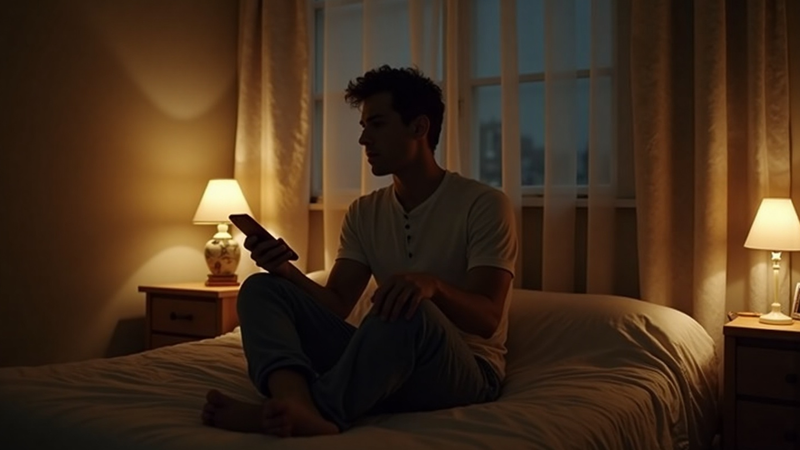

Not wanting to leave home: a red flag or the new normal?
Wanting to stay home is not a symptom. Not being able to leave is. How to tell preference from avoidance, and what actually helps.
In this article
You cancelled again. Not because anything is wrong — the evening was fine, the people were fine, you simply could not make yourself put shoes on. And there was that small, unmistakable relief when the message went through.
Most articles will tell you this is either perfectly fine or a symptom. It is neither, and the difference is not about how often you stay in. It is about what staying in is doing for you.
The honest case for staying home
Something real changed, and it is not a character flaw.
Sometimes this coexists with a life that looks entirely functional from outside — that combination has its own name: high-functioning anxiety.
Work moved into the flat. Friendship moved into a chat. Films, groceries, doctors, banking — all of it arrives without you going anywhere. Leaving the house used to be the default cost of having a life; now it is an optional extra you have to justify.
At the same time, going out got more expensive in every currency. Money, obviously. But also energy: noise, transport, the small social performance of being out among people. If you spent the working day in meetings, the evening out is not recreation, it is the same activity without pay.
So a lot of people who never leave the house are not avoiding anything. They are simply not paying for something they no longer need. That is a preference, and preferences do not require treatment.
Where it stops being a preference
The line is not frequency. Someone can go out twice a month and be perfectly well; someone else can go out four times a week and be quietly falling apart. What matters is the mechanism underneath.
Ask what happens before you cancel, not after.
If the thought of the evening produces a small dread — a tightening, a rehearsal of everything that could go wrong, a hunt for a plausible excuse — that is avoidance, not preference. A preference feels like a choice. Avoidance feels like an escape.
Ask whether the relief is proportionate.
Deciding to stay in when you would rather rest feels mildly pleasant. Cancelling something you were anxious about feels like getting away with something. That surge of relief is the clearest single signal, and it is also the mechanism that makes it worse: relief is a reward, and rewarded behaviour repeats.
Ask whether your world is shrinking.
Preference has a floor: you stop going to the things you dislike and keep the ones you value. Avoidance has no floor. First the loud events go, then the ones with strangers, then the ones requiring transport, then the ones with people you know well. If the list of acceptable outings is shorter than it was a year ago, something is narrowing it.
Ask whether you can still do it when it matters.
The clearest test. If a friend genuinely needed you across town tonight, could you go? If the honest answer is that you would find a way not to — and would feel awful about it — that is no longer preference.
What is usually underneath
Anxiety, most often social. Not fear of people, but fear of being perceived and judged. The evening is not the problem; being watched during it is. Avoidance works instantly and costs you the evidence that it would have been fine.
Depression, specifically anhedonia. Not sadness but flatness: nothing sounds appealing, so why go. The trap is that motivation follows action rather than preceding it — waiting to want to go means never going.
Burnout. Genuinely depleted people are not avoiding, they are out of resource. This one is distinguishable: after a real rest, the desire comes back. If two quiet weeks change nothing, it is not only tiredness.
Habit, plainly. Any behaviour repeated enough becomes the default, and defaults require no reason. Many people who have stopped going out have no psychological explanation at all; they simply stopped, and now leaving takes activation energy that staying does not.
What it costs, honestly
Not going out is not automatically harmful. What is harmful is the loss of things that happen to arrive through going out.
Loneliness is the main one, and it is not the same as being alone. It carries measurable health effects comparable to well-known physical risk factors, and it builds quietly: you can be in contact with people all day by text and still have had no experience of company.
The second cost is narrower and less discussed: you stop collecting evidence. Every time an evening turns out to be fine, your nervous system files it. Every time you cancel, it files nothing — and the imagined version of the evening, which is always worse than the real one, remains unchallenged.
What actually helps
Lower the unit, don't raise the willpower. The instruction "go out more" fails for the same reason "eat less" fails. Twenty minutes at the start of something, with an agreed exit, works because it is small enough not to trigger the dread.
Decide in advance, not on the day. The you who accepted the invitation and the you who has to leave the house are not the same person. Remove the decision from the evening itself: agree to meet someone at the door, buy the ticket, make cancelling cost something.
Attach it to something that already happens. New behaviour survives when it is bolted onto an existing routine. A walk after a specific meeting, coffee after a standing appointment. Standalone plans depend on motivation; attached ones don't.
Separate solitude from isolation. Solitude is chosen and restores you. Isolation is what remains when the choosing stopped. The same evening at home can be either, and only you can tell which one it was.
Treat the anxiety if it is anxiety. If the dread is the driver, going out more without addressing it is exhausting and not particularly effective. Anxiety responds well to treatment — often faster than people expect.
When it is worth taking seriously
- you have avoided something you genuinely wanted to do, more than once;
- the range of acceptable outings has visibly narrowed over the past year;
- you feel dread rather than reluctance in the hours beforehand;
- you cannot remember the last time you were in the same room as someone you like;
- staying in has stopped feeling like rest and started feeling like hiding.
Two or more of these, over a couple of months, is worth a conversation with someone — a friend who will be honest, or a professional.
Putting a number on it helps more than it sounds — the Free Anxiety Test gives you a baseline to compare against later.
The short version
Wanting to stay home is not a symptom. Not being able to leave is. The question is not how many evenings you spend in, but whether you could spend one out if it mattered — and whether the relief when you cancel is a little bit too large.
References
- 1.Holt-Lunstad J. et al.. Loneliness and social isolation as risk factors for mortality, Perspectives on Psychological Science, 2015 (2015)
- 2.World Health Organization. Social isolation and loneliness, 2023 (2023)
- 3.National Institute of Mental Health. Social Anxiety Disorder, 2024 (2024)
- 4.National Institute of Mental Health. Depression, 2024 (2024)
- 5.Craske M. G. et al.. Maximizing exposure therapy: an inhibitory learning approach, Behaviour Research and Therapy, 2014 (2014)
Frequently Asked Questions

Written by
Valentina Lipskaya
Clinical Psychologist · Gestalt Therapist · CBT Specialist · ICF Certified Coach · MBA Professor
Panic Disorder, Anxiety, CBT & Gestalt Therapy
Valentina Lipskaya is a certified clinical psychologist and gestalt therapist specializing in panic disorders, anxiety, and neurological conditions. With over 15 years in psychology and 7 years of hands-on clinical practice, she has helped more than 750+ clients overcome panic, chronic anxiety, and psychosomatic conditions — without medication. Her work at Dzeny translates evidence-based therapeutic methods into practical, accessible guidance for everyday mental health.