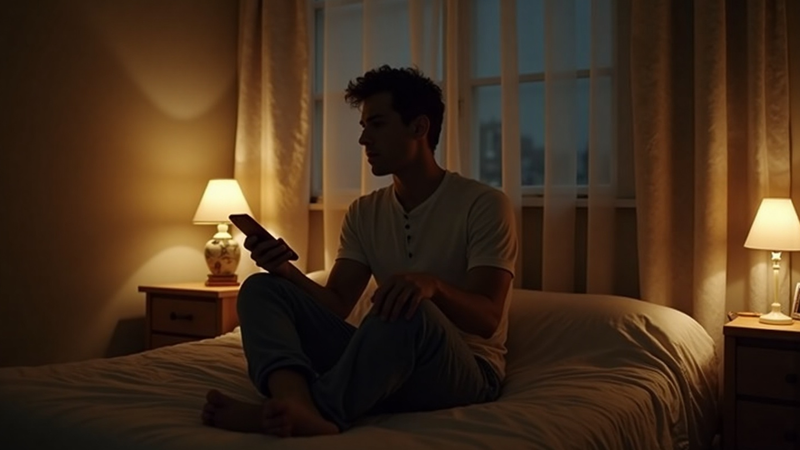

Three habits that quietly keep anxiety alive
Anxiety is often kept alive by three ordinary habits that feel like coping: checking, avoiding and seeking reassurance. Here is how each one works and what to do instead.

In this article
Most advice about anxiety is about what to add: breathing, journalling, exercise, therapy. Useful, all of it. But people who have added everything and still feel no better are usually running something in the background that undoes it.
Anxiety is not only a state. It is also maintained — by ordinary, reasonable-looking behaviours that reduce discomfort now and increase it later. Three of them do most of the work.
Habit one: checking
Rereading the message before sending. Asking a friend again whether it sounded rude. Looking up the symptom one more time. Confirming the door is locked, the invoice is right, the appointment is Thursday.
For why the thinking itself is so hard to step out of, see why we get stuck in anxious thoughts.
Each check feels like diligence, and each one delivers a small, real hit of relief. That is exactly the problem.
Why it backfires. Relief is a reward, and rewarded behaviour repeats. But there is a second, worse effect: checking teaches your brain that the situation *required* checking. Every confirmation is filed not as "it was fine" but as "it was fine because I checked." The next time, the urge arrives slightly stronger.
There is also a strange finding that most people recognise once they hear it: repeated checking makes memory for the check *less* vivid, not more. The more times you verify, the less you trust the verification.
What to do instead. Do not aim for zero — that fails. Aim to delay. Notice the urge, wait ten minutes, then decide. Most urges do not survive the delay, and the ones that do can be acted on without harm. Over a few weeks the delay can grow to an hour, then to indifference.
For messages specifically: one read before sending, then send. The rule has to be mechanical, because judgement is precisely what anxiety distorts.
Habit two: over-preparing
Rehearsing the conversation. Building the third contingency plan. Arriving ninety minutes early. Reading everything about the procedure, the flight, the diagnosis.
This one is the hardest to give up, because it is genuinely rewarded by the world. Prepared people do perform better — up to a point that most anxious people passed long ago.
Why it backfires. Preparation past that point stops being about the task and becomes a way to manage the feeling. And it has a hidden cost: it removes the chance to discover that you would have coped anyway. The belief "I only survived because I over-prepared" is never tested, so it never weakens.
It is also exhausting in a way that damages the actual performance. Turning up to a difficult conversation having already had it four times in your head means turning up depleted, rigid, and thrown by any deviation from the script.
What to do instead. Set the preparation budget in advance — thirty minutes, one draft, one plan — and stop when it is spent, regardless of how you feel. Then, deliberately, leave one small thing under-prepared and watch what happens. It is nearly always fine, and that observation is worth more than any amount of rehearsal.
Habit three: avoidance dressed as preference
The most invisible of the three, because it never announces itself. You do not decline the presentation; you suggest a colleague is better suited. You do not avoid the call; you are simply always busy when it could happen. You do not cancel the trip; the timing is never right.
Why it backfires. Avoidance is the single most effective way to maintain anxiety, and it works by removing evidence. Fear shrinks when it is contradicted by experience — that is the mechanism behind every effective anxiety treatment. Avoidance ensures the contradiction never arrives, and the imagined version of the event, always worse than the real one, stays intact.
It also spreads. The specific thing avoided rarely stays specific: first the presentation, then meetings generally, then any situation where you might be evaluated. Each retreat makes the next one easier.
What to do instead. Look for the phrase "it's just not for me" and ask honestly whether it would still be true if it were easy. If the answer is that you would want it, it is avoidance, not preference.
Then approach in the smallest possible increment — not the presentation, but a comment in a meeting; not the party, but twenty minutes with a planned exit. What matters is not how big the step is but that you stay long enough for the anxiety to drop while you are still there. Leaving at peak fear teaches the wrong lesson.
Why all three feel like good sense
Notice the pattern. Checking looks like conscientiousness. Preparation looks like professionalism. Avoidance looks like self-knowledge. None of them look like symptoms, and other people frequently praise them.
That is why they survive years of good intentions. You cannot give up a habit you have classified as a virtue, and anxiety is unusually good at supplying that classification.
The test is not whether the behaviour is reasonable. It is whether the reassurance lasts. Genuine diligence settles the matter; anxiety-driven diligence buys twenty minutes and then requires more.
What to expect if you stop
It gets briefly worse. This is not a sign of failure — it is the mechanism working. The relief you were getting was real, and removing it leaves the discomfort exposed for a while.
What follows, usually within a few weeks, is a drop in baseline anxiety that no amount of coping technique produces. The urges fade later than the behaviours; still wanting to check while no longer checking is normal progress, not partial failure.
When to get help
- the behaviours take more than an hour a day;
- you cannot delay a check without significant distress;
- avoidance has narrowed your work or social life;
- there are intrusive thoughts you feel compelled to neutralise;
- attempts to stop on your own have failed several times.
The last two in particular are worth professional assessment rather than more self-management. These patterns respond well to structured treatment, and often faster than people expect.
If you are not sure whether this is ordinary stress or something more persistent, the Free Anxiety Test is a quick place to start.
The short version
Anxiety survives on behaviours that look like competence. Checking, over-preparing and quietly opting out all reduce discomfort today at the cost of keeping the fear intact. The way out is not more coping — it is doing slightly less of what has been working.
References
- 1.Craske M. G. et al.. Maximizing exposure therapy: an inhibitory learning approach, Behaviour Research and Therapy, 2014 (2014)
- 2.Salkovskis P. M.. Understanding and treating obsessive-compulsive disorder, Behaviour Research and Therapy, 1999
- 3.Salkovskis P. M. et al.. An experimental investigation of the role of safety-seeking behaviours in the maintenance of panic disorder, Behaviour Research and Therapy, 1999
- 4.National Institute of Mental Health. Anxiety Disorders, 2024 (2024)
- 5.Beesdo K. et al.. Anxiety and anxiety disorders in children and adolescents, Psychiatric Clinics of North America, 2009 (2009)
Frequently Asked Questions

Written by
Valentina Lipskaya
Clinical Psychologist · Gestalt Therapist · CBT Specialist · ICF Certified Coach · MBA Professor
Panic Disorder, Anxiety, CBT & Gestalt Therapy
Valentina Lipskaya is a certified clinical psychologist and gestalt therapist specializing in panic disorders, anxiety, and neurological conditions. With over 15 years in psychology and 7 years of hands-on clinical practice, she has helped more than 750+ clients overcome panic, chronic anxiety, and psychosomatic conditions — without medication. Her work at Dzeny translates evidence-based therapeutic methods into practical, accessible guidance for everyday mental health.