

Transcendental Meditation: A Complete, Honest Guide to the TM Technique
Transcendental Meditation: what it is, how the technique works, and an honest look at the research.
In this article
If you have ever felt like your mind never quite switches off, you are not alone. The idea of sitting quietly and "just relaxing" can feel almost impossible when your thoughts keep racing. That is exactly why so many people are drawn to transcendental meditation — a practice that promises calm without asking you to force your mind into silence.
In this guide, you will learn what transcendental meditation actually is, how the TM technique works, and how it differs from mindfulness and other forms of meditation. You will also get an honest look at the research behind transcendental meditation benefits, realistic expectations, and a gentle way to try a mantra-style practice on your own.
Here is one grounding reframe before we begin: meditation is not about emptying your mind or becoming a perfectly serene person. It is a way of giving your nervous system a break. You do not have to be "good at it," and you do not have to get it right on the first try. You just have to show up.
Key takeaways
Transcendental meditation is a mantra-based technique practiced for about 20 minutes twice a day, prized for feeling effortless rather than forced. Research suggests it may ease stress, anxiety, and blood pressure, though the evidence is mixed and it is not a cure or a replacement for professional care. You can try a gentle, non-trademarked mantra-style practice at home, but for persistent anxiety or low mood it works best alongside other support.
What Is Transcendental Meditation?
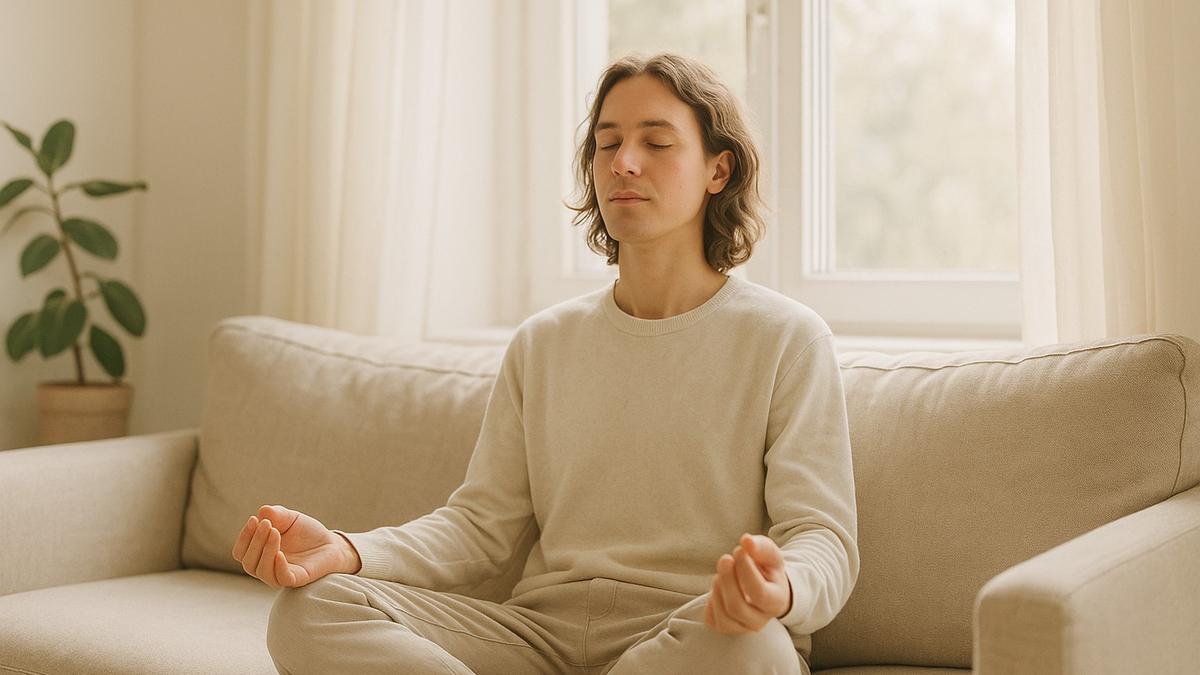
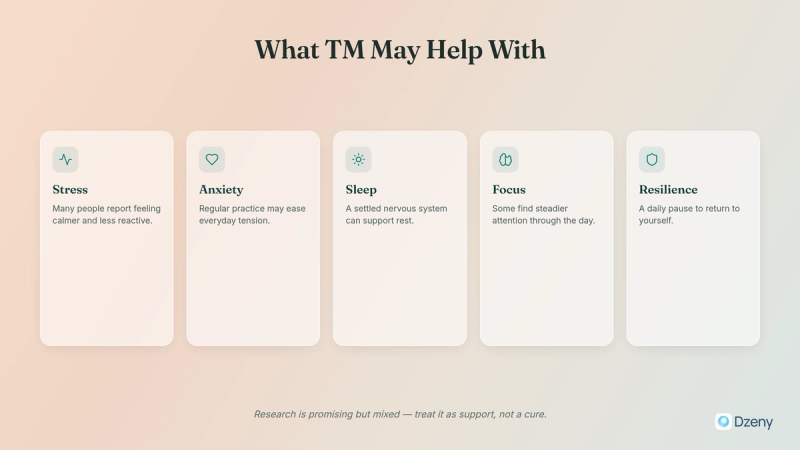
Transcendental meditation, often shortened to TM, is a specific mantra-based meditation technique. You sit comfortably with your eyes closed and silently repeat a mantra — a word or sound with no particular meaning — for about 20 minutes, twice a day.
The practice was popularized in the 1950s and 1960s by Maharishi Mahesh Yogi, who brought it from India to a global audience. Over the decades it gained attention partly through high-profile practitioners and partly through a steady stream of scientific studies. Today it is one of the most widely researched meditation methods in the world.
The core idea: effortless, not forced
What sets transcendental meditation apart is its emphasis on ease. You are not trying to concentrate hard, control your breathing, or push thoughts away. Instead, the mantra gives your attention something gentle to settle on, and your mind is allowed to drift naturally toward a quieter, more restful state.
TM teachers describe this as "effortlessness." If a thought arises — and it will — you simply return to the mantra without judgment. There is no straining, no scorekeeping, and no failure. That soft, permission-giving quality is a big part of why people find it approachable.
How TM Differs From Mindfulness and Other Meditation
Meditation is an umbrella term. Underneath it sit dozens of different techniques, and they are not interchangeable. Understanding where TM fits can help you choose what suits you.
TM vs mindfulness
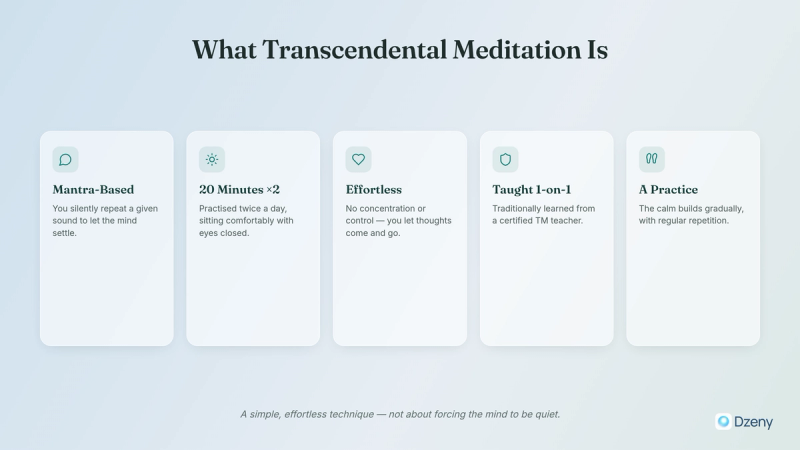
Mindfulness meditation asks you to pay deliberate attention to the present moment — your breath, your body, the sounds around you, or the thoughts passing through your mind. The skill you are building is awareness: noticing what is happening without getting swept away by it.
Transcendental meditation takes a different route. Rather than observing your experience, you use a mantra to let the mind settle inward. TM is often described as a "self-transcending" technique, meaning the goal is to move beyond active thinking into a state of restful alertness, not to observe your thoughts more closely.
Neither approach is better in the abstract. Mindfulness can be wonderful for people who want to build present-moment awareness and catch anxious thought spirals as they start. TM tends to appeal to people who find focused attention effortful and prefer something that feels more passive and restful.
TM vs other mantra and concentration practices
Many traditions use mantras, and many use focused concentration. What makes TM distinctive is the combination of a personally assigned mantra, a structured teaching method, and that consistent emphasis on effortlessness. Concentration-based practices often ask you to hold your focus tightly. TM deliberately does the opposite — the moment it starts to feel like work, you have drifted away from how it is meant to be practiced.
Not sure which style of meditation actually fits you?
Dzeny can talk you through the difference between focusing and letting go, and guide a short, no-pressure practice so you can feel what "effortless" really means — privately, whenever your mind needs a break.
Talk to DzenyNo sign-up or card needed
How Transcendental Meditation Is Traditionally Taught
One thing to know upfront: TM is a trademarked technique, and traditionally it is taught in person by certified teachers through a structured course. This matters if you want the authentic method rather than an approximation.
The standard course structure
A traditional TM course usually runs over several consecutive days. It typically includes an introductory talk, a personal instruction session where you receive your mantra, and follow-up meetings to refine your practice. The personalized instruction and ongoing support are a core part of what you are paying for.
The mantra
In official TM, your mantra is selected for you by your teacher and kept private. The mantras are sounds without literal meaning, chosen so that your attention can rest on them without triggering associations or analysis. Teachers emphasize keeping the mantra to yourself, which is part of the tradition around the practice.
Because certified courses can be a significant financial commitment, some people look for lower-cost or free alternatives. That is completely reasonable — and later in this article you will find a gentle, non-trademarked mantra-style practice you can try on your own. Just keep in mind it is an approximation, not the official TM technique.
What Actually Happens in a Session
Let's demystify the experience, because the reality is refreshingly ordinary.
You find a comfortable seat — a chair is fine, no special posture required. You close your eyes, sit for a few moments, and then begin silently repeating your mantra. You do not chant it out loud or match it to your breath. You simply let it play softly in your mind.
Thoughts will come. You might plan your day, replay a conversation, or notice a sound. When you realize you have drifted, you gently come back to the mantra. Sometimes the mantra itself fades or changes, and that is fine too. After about 20 minutes, you stop repeating it, keep your eyes closed for a couple of minutes, and then slowly open them.
Many people describe the state as being deeply relaxed yet still awake — a settled, quiet feeling. Others simply feel a bit calmer and less wound up. Both are perfectly normal outcomes.
Evidence and Benefits: An Honest Look
Transcendental meditation is among the more studied meditation techniques, and there is genuine research interest in its effects on stress and cardiovascular health. It is worth being clear-eyed about what the evidence does and does not show.
Stress and anxiety
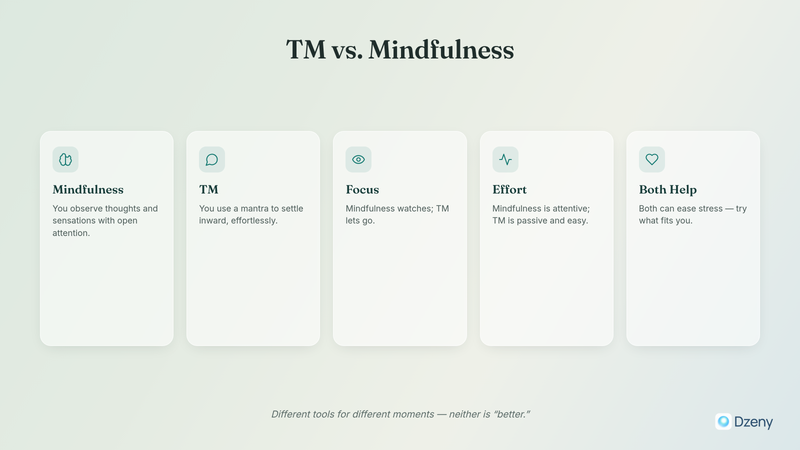
Several studies suggest that regular TM practice may help reduce stress and symptoms of anxiety. The proposed mechanism is that the restful state lowers physiological arousal — the fight-or-flight response that keeps so many of us on edge. That said, the quality of studies varies, some have small sample sizes, and researchers continue to debate how much of the benefit is specific to TM versus general to regular meditation and relaxation.
Blood pressure and heart health
TM has drawn particular attention for its potential effect on blood pressure. Some research and reviews have found modest reductions in blood pressure among people who practice regularly, and a few professional bodies have acknowledged meditation as a possible complementary approach for cardiovascular risk. Even so, the findings are mixed, effect sizes are often small, and meditation is not a replacement for medical treatment.
The honest bottom line
The most accurate summary is this: transcendental meditation may offer real benefits for stress, anxiety, and general wellbeing for many people, but the research is ongoing and mixed rather than definitive. Be cautious of any source that promises dramatic, guaranteed results. A calmer, more regulated nervous system is a realistic hope. A cure for anxiety, depression, or high blood pressure is not something any meditation can promise.
Realistic Expectations and Limitations
Meditation is a skill and a habit, not a magic switch. Here is what a realistic path tends to look like.
In the first few weeks, you may not notice much beyond feeling a little calmer right after sitting. Over time — often a month or two of consistent practice — many people report sleeping better, reacting to stress more slowly, or simply feeling steadier. Progress is usually gradual and easy to miss day to day.
There are also limitations. Meditation can be uncomfortable for some people, especially those with a trauma history, where sitting quietly with the mind can surface distressing feelings. If meditation consistently increases your distress rather than easing it, that is important information, and it is completely valid to stop and seek other support. On days like that, meeting yourself with a little self-compassion — the same kindness you would offer a friend — often helps more than pushing through. Meditation is one tool among many, not a universal solution.
How to Try a Simple Mantra-Style Practice Yourself
If you are curious but not ready to commit to a course, you can explore a gentle, mantra-style practice at home. To be clear, this is a non-trademarked approximation inspired by mantra meditation — not the official TM technique — but it can still be soothing and a good way to see whether this style suits you.
A step-by-step approach
1. Set aside 10 to 20 minutes. Pick a quiet-ish time, perhaps morning and early evening. Twice a day is ideal, but once is a fine start.
2. Sit comfortably. A chair with your feet on the floor works well. You do not need a cushion or a special posture.
3. Close your eyes and settle. Take a few natural breaths and let your shoulders drop.
4. Choose a simple, neutral sound. A soft, meaningless syllable like "ah-um" or "shi-rim" works. The point is that it carries no strong meaning to pull you into thinking.
5. Repeat it silently and gently. Let it play in your mind without effort. Do not force a rhythm or tie it to your breath.
6. When you drift, come back. Thoughts are normal. Each time you notice, softly return to the sound. No frustration required.
7. Come out slowly. After your time is up, stop the sound, sit quietly for a minute or two, then open your eyes and ease back into your day.
The whole spirit of this is gentleness. If it feels like a chore or a test, you are trying too hard.
Sitting still leaves you more wound up, not less?
If quiet time tends to hand the microphone to your worries, Dzeny can guide a CBT-based grounding exercise instead, help you name what is racing, and steady your breathing in the moment — an always-on companion for the harder sits.
Talk to DzenyNo sign-up or card needed
Common Challenges (and How to Meet Them)
Even with an "effortless" practice, most people run into a few predictable hurdles.
"My mind won't stop." It is not supposed to. A busy mind is not a sign of failure — it is the reason you are meditating. Returning to the mantra again and again *is* the practice.
"I keep falling asleep." That often means you are tired, which is useful to notice. Try sitting more upright, or meditate at a time when you are less depleted.
"I don't have 40 minutes a day." Start smaller. Five or ten minutes once a day still counts. Consistency matters more than duration.
"I don't feel anything." Benefits are often cumulative and subtle. Rather than chasing a dramatic experience, notice how you feel across your day over a few weeks.
TM for Anxiety and Stress Specifically
If anxiety or chronic stress is what brought you here, it helps to understand the connection. Anxiety keeps your body in a heightened, alert state — racing heart, shallow breath, a mind scanning for threats. A restful meditation practice works in the opposite direction, giving your nervous system regular chances to downshift.
For many people, a mantra-style practice pairs well with other tools. You might combine it with breathing exercises for anxiety for moments when you feel activated, and with practical strategies for managing anxiety in your daily life. Meditation is rarely a standalone fix, but as part of a broader toolkit it can genuinely help you feel more grounded.
That said, if your anxiety is intense, persistent, or interfering with your work, sleep, or relationships, meditation alone is unlikely to be enough — and that is not a personal failing.
When Meditation Isn't Enough — and Seeking Support
Meditation is a wonderful practice, but it is not therapy, and it is not a treatment for a mental health condition. There are clear signs it is time to reach out for more support: when anxiety or low mood lasts for weeks, when it disrupts your daily functioning, when you are using substances to cope, or when you have any thoughts of harming yourself. In those moments, please reach out to a qualified professional or a crisis line in your country.
Asking for help is not a sign that you have failed at self-care. It is one of the most self-respecting things you can do.
When to reach out for help now
If you are having thoughts of harming yourself, please do not wait and do not stay alone with it. In the US, call or text 988 (Suicide & Crisis Lifeline), available 24/7; outside the US, contact your local emergency services or a crisis line. Meditation is a supportive practice, not a substitute for professional care in a crisis.
How Dzeny can help
If you would like structured, always-available support alongside a practice like this, Dzeny is an AI mental-health companion built on cognitive behavioral therapy (CBT) principles, with calming exercises and guided practices available 24/7. In an eight-week study with Synergy University Dubai involving 280 adults, participants using Dzeny reported a 43% reduction in anxiety symptoms, and the platform now supports more than 48,000 active users. It is not a replacement for a human therapist or crisis care, but it can be a warm, judgment-free place to check in, learn skills, and stay steady between the harder moments.
Frequently Asked Questions
What is transcendental meditation in simple terms?
Transcendental meditation is a mantra-based technique where you silently repeat a specific sound for about 20 minutes twice a day, with your eyes closed. Unlike mindfulness, it is designed to feel effortless — you let your mind settle inward rather than actively focusing. It was popularized by Maharishi Mahesh Yogi and is traditionally taught by certified teachers.
How is TM different from mindfulness meditation?
Mindfulness trains you to observe the present moment — your breath, thoughts, and sensations — with awareness. TM instead uses a mantra to let the mind quiet down and settle into a restful state, without observing or analyzing your experience. Mindfulness builds awareness; TM emphasizes effortless rest.
How long does it take to see transcendental meditation benefits?
Many people feel calmer right after a session from the start, but deeper benefits like better stress resilience and sleep usually build over several weeks of consistent practice. Progress tends to be gradual and easy to overlook day to day. Consistency matters more than intensity.
Do I have to pay for a course to learn TM?
The official, trademarked TM technique is traditionally taught through a paid course with a certified teacher, including a personal mantra and follow-up support. You do not have to take a course to explore mantra-style meditation, though. A gentle, non-trademarked approximation can be practiced at home for free, even if it is not the exact TM method.
Is transcendental meditation scientifically proven?
TM is one of the more researched meditation techniques, and studies suggest possible benefits for stress, anxiety, and blood pressure. However, the research is mixed and ongoing, with variation in study quality and effect sizes. It may help, but it should not be treated as a guaranteed cure or a replacement for medical care.
Can transcendental meditation help with anxiety?
For many people, regular practice can ease stress and anxiety by giving the nervous system a chance to calm down. It works best as part of a broader toolkit that may include breathing techniques, therapy, or support tools. If your anxiety is severe or persistent, meditation alone is usually not enough, and professional help is worthwhile.
How do I choose a mantra if I practice on my own?
For a home practice, pick a short, neutral sound with no strong meaning, such as a soft syllable like "ah-um." The idea is that a meaningless sound gives your attention something gentle to rest on without pulling you into thinking. In official TM, your mantra is assigned by a certified teacher and kept private.
What should I do if meditation makes me feel worse?
If sitting quietly consistently increases distress — which can happen, especially with a trauma history — it is completely valid to stop. Meditation is one tool among many, not a requirement. Consider gentler grounding practices or reaching out to a mental health professional who can help you find approaches that feel safe for you. This article is for information only and is not a substitute for professional medical or psychological care; if you are struggling or having thoughts of harming yourself, please reach out for help right away.
If you are not sure whether this is ordinary stress or something more persistent, the Free Anxiety Test is a quick place to start.
Sources
- National Center for Complementary and Integrative Health (NCCIH) — nccih.nih.gov
- Agency for Healthcare Research and Quality (AHRQ) — Meditation reviews
- American Heart Association — Meditation and heart health
- Mayo Clinic — Meditation
- American Psychological Association (APA) — apa.org
- Dzeny x Synergy University Dubai clinical study (280 adults, 8 weeks)
Written by the Dzeny clinical team. Reviewed by Valentina Lipskaia, Clinical Psychologist & Founder of Dzeny.

Written by
Valentina Lipskaya
Clinical Psychologist · Gestalt Therapist · CBT Specialist · ICF Certified Coach · MBA Professor
Panic Disorder, Anxiety, CBT & Gestalt Therapy
Valentina Lipskaya is a certified clinical psychologist and gestalt therapist specializing in panic disorders, anxiety, and neurological conditions. With over 15 years in psychology and 7 years of hands-on clinical practice, she has helped more than 750+ clients overcome panic, chronic anxiety, and psychosomatic conditions — without medication. Her work at Dzeny translates evidence-based therapeutic methods into practical, accessible guidance for everyday mental health.