

Rejection Sensitive Dysphoria: Why Small Moments Hurt So Much (and How to Cope)
Rejection sensitive dysphoria: why rejection hurts so intensely and how to cope.

In this article
You send a text and get no reply for an hour. Rationally, you know your friend is probably just busy. But something in your chest tightens, and within minutes you've convinced yourself they're annoyed with you, that you said something wrong, that maybe the whole friendship is quietly falling apart. By the time they answer with a cheerful "sorry, was in a meeting!", you've already lived through a small emotional catastrophe.
If that pattern sounds familiar, you're not being dramatic, and you're not "too much." You may be experiencing something called rejection sensitive dysphoria — an intense, sometimes physical reaction to real or perceived rejection, criticism, or failure. This article walks through what rejection sensitive dysphoria actually is, why it's so closely tied to ADHD, how to recognize its symptoms, and — most importantly — evidence-based ways to soften its grip on your daily life.
Here's the reframe to carry with you as you read: the depth of your reaction is not a character flaw. It's a nervous system that registers emotional pain at a higher volume than most. That's something you can learn to work with, not something that makes you broken.
Key takeaways
Rejection sensitive dysphoria (RSD) is an intense, often physical reaction to real or perceived rejection, criticism, or failure — faster, bigger, and longer-lasting than ordinary sensitivity. It's not a formal diagnosis, but it's a real, recognizable pattern most strongly linked to how the ADHD brain regulates emotion. You can't switch off a sensitive nervous system, but you can change your relationship to it with cognitive reframing, naming the wave, self-compassion, and support.
What Rejection Sensitive Dysphoria Is (and Isn't)
Rejection sensitive dysphoria, often shortened to RSD, describes an extreme emotional sensitivity to the experience — or even just the possibility — of being rejected, criticized, or seen as falling short. The word *dysphoria* comes from Greek and roughly means "difficult to bear," which captures the feeling well. For someone with RSD, a moment of perceived rejection doesn't sting for a second; it can feel unbearable, like a wave crashing over you all at once.
The term was coined by psychiatrist Dr. William Dodson, who noticed that many of his patients with attention-deficit/hyperactivity disorder described this same overwhelming reaction. It's worth being clear here: RSD is not a formal diagnosis in the DSM-5 (the manual clinicians use to classify mental health conditions). It's a descriptive term — a useful label for a real, lived pattern that many people recognize instantly once they hear it named.
What RSD is not
It helps to name a few things RSD isn't, because misunderstanding it can add another layer of shame:
- It isn't attention-seeking or manipulation. The reaction is internal and often hidden; many people with RSD work hard to *conceal* how much something hurt.
- It isn't the same as low self-esteem, though the two can overlap. You can have healthy self-worth on a good day and still be flattened by a single offhand comment.
- It isn't a personality defect. It's a pattern of emotional processing, closely linked to how certain brains are wired.
RSD and ADHD: The Link
The single strongest association with RSD is ADHD. While RSD can appear in other contexts, Dr. Dodson estimated that emotional hypersensitivity of this kind is one of the most common — and most overlooked — features of ADHD in adults.
Why the connection? Researchers believe it comes down to how the ADHD brain regulates emotion. ADHD isn't only about attention; it also affects the brain's ability to modulate the *intensity* of feelings. Where a neurotypical brain might register mild disappointment and move on, an ADHD brain can experience that same event at full volume, with little of the internal "dimmer switch" that would normally take the edge off.
There's also a learned component. Many people with ADHD grow up hearing an accumulation of correction — "try harder," "why can't you just focus," "you're so careless." By adulthood, the nervous system has been primed to expect criticism and to brace against it. That lifetime of small wounds can make the threat of rejection feel enormous, because on some level it echoes thousands of earlier moments.
If you're navigating an ADHD diagnosis, understanding RSD can be genuinely liberating. It reframes a "too sensitive" personality trait as a recognizable, manageable part of your neurology — something with real strategies attached.
Symptoms of Rejection Sensitive Dysphoria
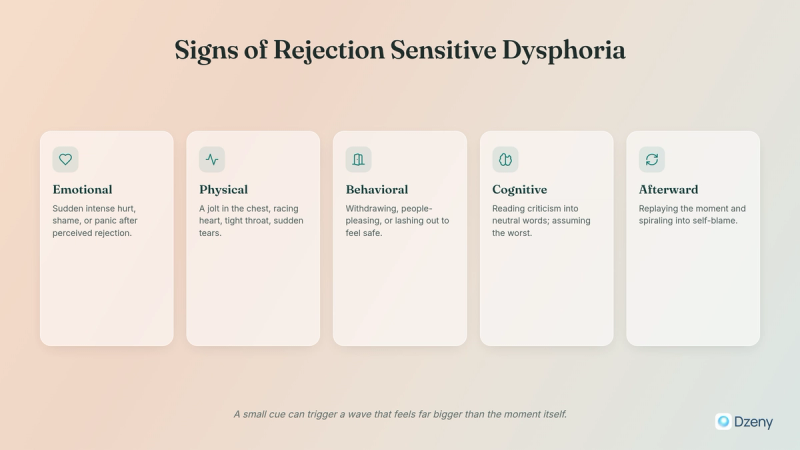
RSD shows up across emotional, physical, and behavioral channels. You may recognize yourself in some of these and not others; it's rarely all-or-nothing.
Emotional symptoms
- Sudden, intense waves of hurt, shame, or sadness after perceived rejection or criticism
- Feeling emotionally "flooded" — the reaction is bigger and faster than the situation seems to call for
- Sharp swings from feeling fine to feeling devastated in a matter of seconds
- Internalizing criticism as proof that you are fundamentally unlovable or inadequate
- For some people, the pain turns outward instead — as sudden anger or defensiveness
Physical symptoms
- A physical "gut punch" sensation in the chest or stomach
- Racing heart, tight throat, or a sudden hot or cold flush
- Fatigue or a heavy, drained feeling after an emotional spike
- Trouble sleeping while replaying the moment on a loop
Behavioral symptoms
- People-pleasing: going to great lengths to avoid any possibility of disappointing others
- Perfectionism, driven by the fear that any mistake will trigger rejection
- Avoidance: not applying for the job, not asking someone out, not raising your hand — because the risk of "no" feels too dangerous
- Withdrawing quickly from relationships at the first hint of distance
- Overanalyzing conversations, texts, and facial expressions for hidden signs of disapproval
What Causes Rejection Sensitive Dysphoria?
There's no single cause, and honestly, the science is still developing. But a few contributing threads come up consistently.
Neurological wiring. As noted above, differences in emotional regulation — particularly in ADHD — appear to be central. The brain's threat-detection and emotion-modulation systems seem calibrated to react strongly and quickly.
Early experiences. Repeated experiences of criticism, exclusion, bullying, or conditional approval in childhood can teach the nervous system that rejection is both likely and dangerous. This is especially common for neurodivergent kids who spent years feeling "different."
Temperament. Some people are simply born more sensitive — more attuned to their environment and to other people's moods. This trait has real strengths (empathy, perceptiveness, emotional depth), but it can also amplify the pain of rejection.
Most likely, RSD emerges from a combination: a sensitive, differently-wired brain meeting a world that delivered a lot of early "you're doing it wrong" messages.
How RSD Differs From Ordinary Sensitivity
Everyone dislikes being rejected — that's human. So what makes RSD different from simply caring what people think?
The difference is mostly in intensity, speed, and duration. Ordinary sensitivity might mean feeling a bit deflated after criticism and then recovering over the course of an hour. RSD tends to be:
- Faster — the reaction hits almost instantly, before you can think it through.
- Bigger — the emotional response is disproportionate to the trigger. A neutral comment can land like a devastating verdict.
- Physical — it's felt in the body, not just the mind.
- Longer-lasting or looping — the moment can replay for hours or days, each replay reigniting the hurt.
- Global — instead of "that was an awkward moment," the mind jumps to "I always ruin everything" or "no one really likes me."
If your reactions to rejection routinely feel like emergencies — sudden, physical, and out of proportion — that's the signature of RSD rather than everyday sensitivity.
The Internal Spiral: How a Small Cue Becomes a Big Reaction
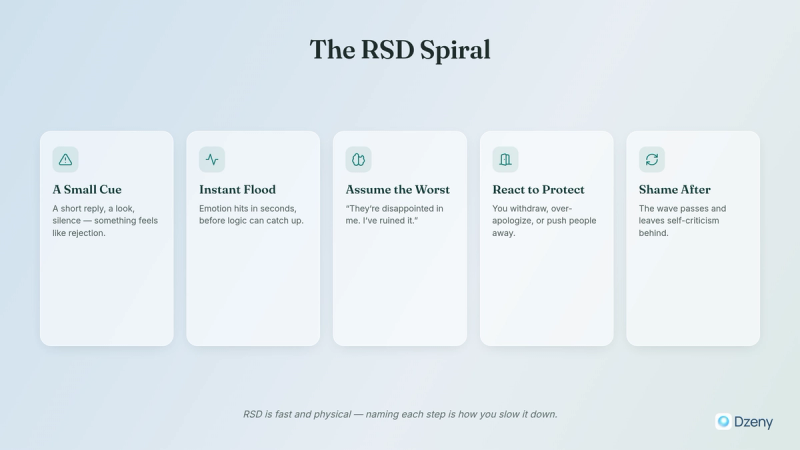
Understanding the *mechanics* of an RSD spiral is one of the most useful things you can do, because it gives you places to intervene. It usually unfolds in a predictable sequence:
1. The cue. Something small and often ambiguous happens — a short reply, a canceled plan, a colleague's neutral tone, a friend who seems distant.
2. The instant interpretation. Before conscious thought kicks in, your brain fills the ambiguity with the worst reading: *They're upset with me. I did something wrong.*
3. The emotional flood. The interpretation triggers a full-body wave of hurt or shame. This is the "dysphoria" — fast, intense, physical.
4. The story. The mind builds a narrative around the feeling: *This always happens. I'm too much. People eventually leave.*
5. The reaction. You withdraw, over-apologize, lash out, or spiral into rumination — behaviors that can, ironically, create the very distance you feared.
The crucial insight is that steps 2 and 4 — the *interpretations* and *stories* — are not facts. They're the brain's automatic guesses, made under emotional pressure. And guesses can be examined, questioned, and revised. That gap between the cue and your response, however small, is where recovery lives.
The unanswered text landed like a verdict, and the spiral is already spinning.
Dzeny is an AI companion built on cognitive behavioral therapy principles that can help you catch the story in step 4, weigh the actual evidence, and widen the lens in the exact moment the wave hits — privately, without judgment, any hour of the day or night.
Talk to DzenyNo sign-up or card needed
When RSD Becomes a Problem — and a Note on Diagnosis
Not every strong reaction to rejection needs "fixing." Sensitivity is part of being human, and often part of being deeply empathetic. RSD becomes a problem worth addressing when it starts to:
- Keep you from pursuing goals, relationships, or opportunities you genuinely want
- Cause significant, recurring distress that's hard to recover from
- Drive patterns like chronic people-pleasing, avoidance, or conflict that hurt your wellbeing
- Contribute to anxiety, low mood, or burnout
A quick, honest note on diagnosis: because RSD isn't a standalone DSM diagnosis, a clinician won't hand you an "RSD diagnosis" the way they might for depression. Instead, a good mental health professional will look at the whole picture — often exploring ADHD, anxiety, or mood conditions, and treating the emotional sensitivity as part of that broader assessment. If RSD language resonates with you, it's absolutely worth raising with a professional; it's a helpful starting point for a real conversation.
Evidence-Based Ways to Cope With Rejection Sensitive Dysphoria
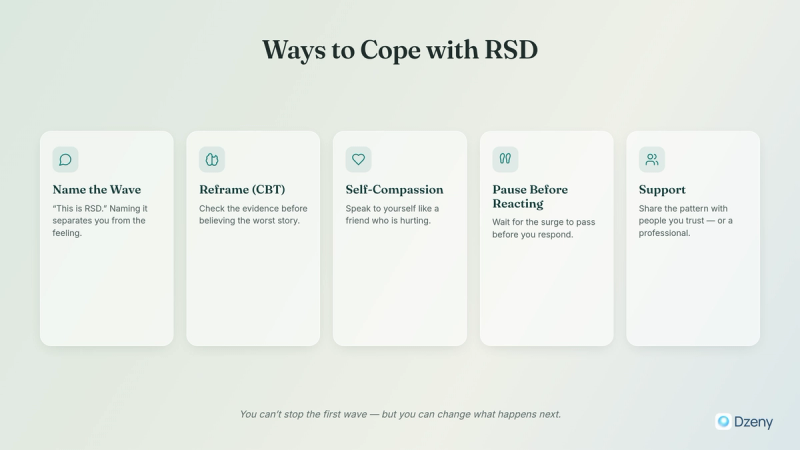
Here's the hopeful part. While you may not be able to switch off a sensitive nervous system, you can absolutely change your relationship to it. These strategies draw on approaches with strong evidence behind them, especially cognitive behavioral therapy (CBT).
Cognitive reframing (challenging the automatic story)
At the heart of CBT is a simple, powerful idea: our feelings follow our thoughts, and our automatic thoughts are often distorted. When an RSD spiral hits, try gently interrogating the interpretation:
- *What's the actual evidence they're rejecting me?*
- *What are three other explanations for what just happened?*
- *If a close friend told me this story, what would I say to them?*
You're not forcing false positivity. You're widening the lens so the worst-case reading isn't the only one your brain gets to run with.
Naming the wave
One of the most effective in-the-moment tools is simply to *name what's happening*: "This is an RSD wave. It's intense, and it will pass." Naming an emotion has been shown to reduce its intensity by engaging the thinking part of the brain. It also reminds you that the feeling is a temporary state, not a permanent truth. Waves crest — and then they recede.
Self-compassion
RSD thrives on self-criticism. Practicing self-compassion — treating yourself with the same kindness you'd offer a friend — directly counters that. When the shame hits, try placing a hand on your chest and offering yourself a genuinely kind sentence: *This really hurts right now, and it makes sense that it does.* This isn't indulgent; research consistently links self-compassion to greater emotional resilience.
It's 11 p.m., the wave has crested, and there's no one awake to reality-check the story.
Between sessions, Dzeny can walk you through naming the wave, offer a kinder counter-sentence to the self-criticism, or help you draft a gentle reality-checking message before you react — a private, always-on companion for the moments the spiral hits hardest.
Talk to DzenyNo sign-up or card needed
Communication and repair
When you feel a wave rising in a relationship, a small script can help you check reality before you react: "I noticed I felt a bit anxious when you went quiet — is everything okay between us?" This does two things at once: it tests your interpretation against reality, and it invites reassurance instead of driving distance. Letting trusted people know that you tend to feel rejection intensely can also help them respond with care rather than confusion.
Lifestyle foundations
Your emotional resilience runs on your body. Sleep deprivation, chronic stress, low blood sugar, and skipped meals all lower your threshold for emotional flooding. Regular sleep, movement, nourishment, and moments of genuine rest won't cure RSD, but they meaningfully raise the level at which the wave breaks. If anxiety often rides alongside your sensitivity, our guide to managing anxiety pairs well with these tools.
Professional help
If RSD is significantly affecting your life, working with a therapist can be transformative. CBT and its relatives (like dialectical behavior therapy, which teaches concrete emotion-regulation skills) are well-suited to this work. If ADHD is part of your picture, an assessment and treatment plan can also reduce the emotional dysregulation that fuels RSD. There's no prize for going it alone.
When to Seek Help
Reach out to a mental health professional if you notice that:
- Rejection sensitivity is regularly interfering with your work, relationships, or self-worth
- You're avoiding important parts of life to protect yourself from the possibility of "no"
- The lows are getting deeper, longer, or harder to climb out of
- You suspect undiagnosed ADHD underneath the pattern
Asking for help isn't a sign that RSD has won. It's one of the most effective moves you can make. Understanding social anxiety and how it interweaves with rejection fears can also be a useful part of that conversation.
When to reach out for help now
If you ever have thoughts of self-harm or that life isn't worth living, please don't wait — reach out right away. In the US, call or text 988 (Suicide & Crisis Lifeline), available 24/7; outside the US, contact your local emergency services or a crisis line. This article is for information only and is not a substitute for professional medical or psychological care.
How Dzeny Can Help
Learning to ride RSD waves takes practice, and it helps to have support in the exact moment a spiral starts — which is rarely during business hours. Dzeny is an AI mental-health companion built on CBT principles, available 24/7 by voice or text. When a wave hits at 11 p.m. after an unanswered message, you can talk it through, get help reframing the automatic story, and steady yourself before the spiral takes hold. In a study conducted with Synergy University Dubai (280 adults over 8 weeks), participants saw a 43% reduction in anxiety symptoms, and today more than 48,000 people use Dzeny as a steady, judgment-free place to land. It's not a replacement for a therapist, but it can be a warm hand to hold between sessions — and in the moments no one else is awake.
Frequently Asked Questions
Is rejection sensitive dysphoria a real diagnosis?
RSD is not a formal diagnosis in the DSM-5, the manual clinicians use to classify mental health conditions. It's a descriptive term, coined by Dr. William Dodson, for a very real and recognizable pattern of intense emotional sensitivity to rejection. Clinicians typically address it within the context of ADHD, anxiety, or mood conditions rather than as a standalone diagnosis.
What is the difference between RSD and normal rejection sensitivity?
Almost everyone dislikes rejection, but RSD reactions are faster, more intense, more physical, and longer-lasting than ordinary sensitivity. A small or ambiguous cue can trigger a full-body wave of shame or hurt that feels disproportionate to what actually happened. If your reactions to rejection routinely feel like emergencies, that leans toward RSD.
Why is RSD so common in people with ADHD?
The ADHD brain tends to regulate emotional intensity differently, experiencing feelings at full volume with less of a natural "dimmer switch." On top of that, many people with ADHD grow up hearing a lot of correction and criticism, which primes the nervous system to expect and brace against rejection. Together, these make emotional hypersensitivity one of the most common features of adult ADHD.
Can rejection sensitive dysphoria be treated?
Yes. While you may not be able to switch off a sensitive nervous system, you can change your relationship to it. Cognitive behavioral therapy, self-compassion practices, emotion-regulation skills, and — where relevant — ADHD treatment all help meaningfully reduce how much RSD disrupts your life. An AI companion like Dzeny can offer daily support and skills practice between sessions, but it doesn't replace a professional for serious conditions.
How do I calm down during an RSD episode?
In the moment, name what's happening ("this is an RSD wave, and it will pass"), which lowers the emotional intensity by engaging your thinking brain. Then gently question the worst-case interpretation and offer yourself a kind, understanding sentence. If it involves another person, a simple reality-checking question can replace the spiral with reassurance.
Does RSD only affect people with ADHD?
No. RSD is most strongly associated with ADHD, but sensitivity to rejection can also show up in the context of anxiety, trauma histories, or a naturally sensitive temperament. If the pattern resonates with you, it's worth exploring with a professional regardless of whether you have an ADHD diagnosis.
Is RSD the same as anxiety or depression?
Not exactly, though they often overlap. RSD specifically centers on intense reactions to rejection, criticism, or failure, whereas anxiety and depression are broader conditions. Untreated RSD can feed into anxiety and low mood, and the reverse is also true, which is why a full assessment looks at the whole picture.
When should I see a professional about RSD?
Consider reaching out if rejection sensitivity is regularly interfering with your work, relationships, or self-worth, if you're avoiding important opportunities to protect yourself from "no," or if the emotional lows are getting deeper and harder to recover from. If you ever have thoughts of self-harm, seek urgent support right away.
For a structured look at how you see yourself, the Free Self-Esteem Test uses the Rosenberg scale.
Sources
- Dodson, W. — ADDitude (additudemag.com) on Rejection Sensitive Dysphoria
- CHADD — Children and Adults with ADHD (chadd.org)
- American Psychological Association (APA) — apa.org
- Cleveland Clinic — Rejection Sensitive Dysphoria
- National Institute of Mental Health (NIMH) — ADHD
- Dzeny x Synergy University Dubai clinical study (280 adults, 8 weeks)
Written by the Dzeny clinical team. Reviewed by Valentina Lipskaia, Clinical Psychologist & Founder of Dzeny.

Written by
Valentina Lipskaya
Clinical Psychologist · Gestalt Therapist · CBT Specialist · ICF Certified Coach · MBA Professor
Panic Disorder, Anxiety, CBT & Gestalt Therapy
Valentina Lipskaya is a certified clinical psychologist and gestalt therapist specializing in panic disorders, anxiety, and neurological conditions. With over 15 years in psychology and 7 years of hands-on clinical practice, she has helped more than 750+ clients overcome panic, chronic anxiety, and psychosomatic conditions — without medication. Her work at Dzeny translates evidence-based therapeutic methods into practical, accessible guidance for everyday mental health.