
Morning anxiety: why the first 10 minutes set the whole day
Why anxiety peaks in the first hour after waking, the three habits that make it worse, and a ten-minute sequence that changes how the rest of the day goes.
In this article
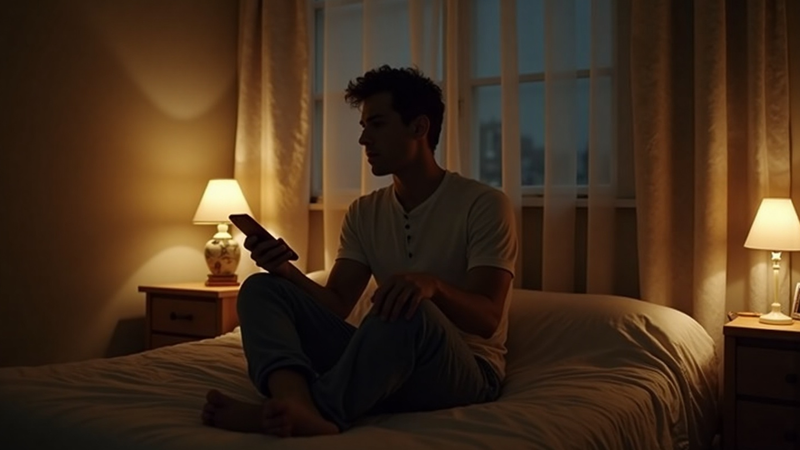
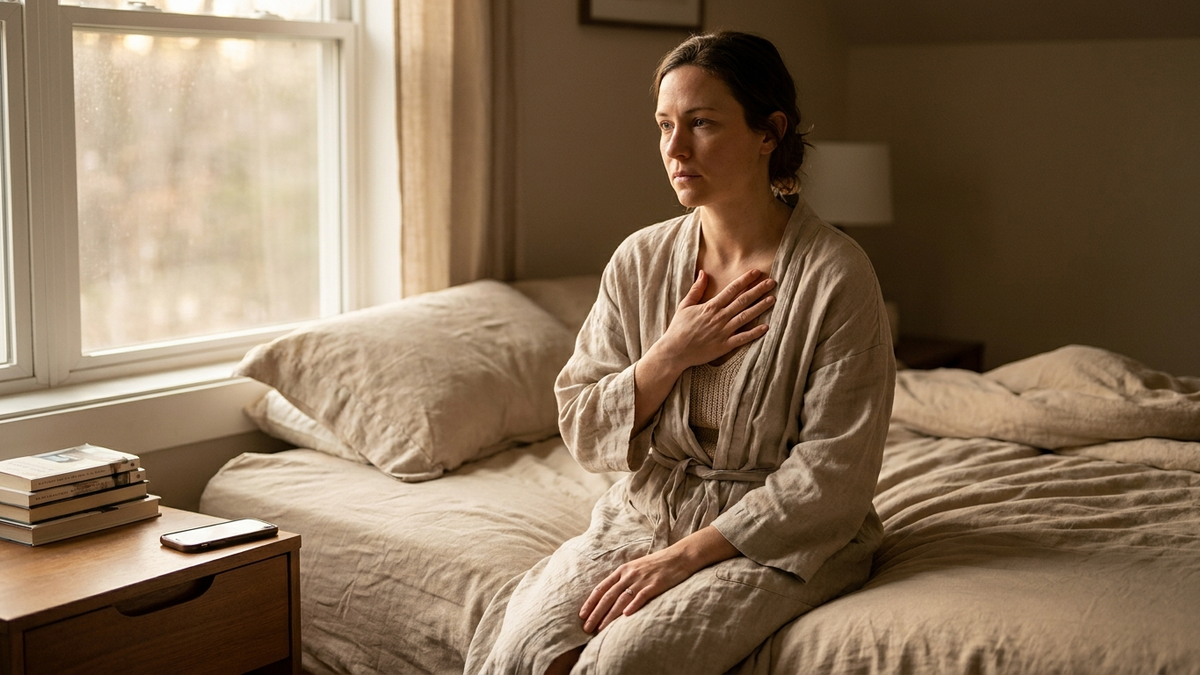
You open your eyes and it is already there. Nothing has happened yet — no message, no bad news, not even a conversation — and your chest is tight, your jaw is set, and your mind has started listing everything that could go wrong today.
Morning anxiety is one of the most common complaints people bring to mental health apps, and one of the least understood. It is not a character flaw and it is not a sign that your day is doomed. It has a mechanism, and once you know it, the first ten minutes stop working against you.
What you will learn
Why mornings are the worst time
Cortisol, the hormone most associated with stress, follows a daily rhythm. It rises sharply in the thirty to forty-five minutes after you wake — this is called the cortisol awakening response, and it is normal. Its job is to get you upright and moving.
Mornings often start badly because the night did — see sleep anxiety for the other half of the pattern.
The problem is that cortisol does not know the difference between "get up and start the day" and "something is wrong." If you are already carrying a load of unresolved stress, that morning surge arrives on top of it and your body reads the whole thing as alarm. You wake up with the physiology of fear and then go looking for a reason to explain it.
That search is what turns a hormonal event into a bad day. The body produces the signal first; the mind supplies a story afterwards. And at seven in the morning, with no evidence to the contrary, the story is rarely generous.
Three things that make it worse
Reaching for the phone
News and social media in the first minutes deliver a stream of things that are both alarming and entirely outside your control. You have handed your nervous system a threat it cannot act on, at the exact moment it is most primed to respond. Everything after that is downstream of that choice.

Starting with sugar and caffeine on an empty stomach
A carbohydrate-heavy breakfast and strong coffee before any food produce a spike and then a drop, and the drop feels almost identical to anxiety: shaky hands, racing heart, difficulty concentrating. Many people spend the late morning treating a blood sugar problem as an emotional one.
Trying to solve everything before your feet are on the floor
Lying in bed running through the day is not planning. Planning involves writing things down and deciding what happens first. What happens in bed is rehearsal — the same worries cycling with no output, which is the most reliable way to raise anxiety without producing anything useful.
Waking up anxious more days than not?
Dzeny is an AI companion for mental health. Talk through what the morning is actually about, and build a routine that works for your life — privately, at any hour.
Try DzenyNo card required
A ten-minute sequence that works
None of this is complicated. It works because it gives the cortisol surge somewhere to go and gives your mind something concrete to do before it starts inventing.
Minutes 1-2: do not reach for the phone
Leave it face-down or in another room. If you use it as an alarm, put it far enough away that you have to stand up. The single change most people report as helpful is not meditating — it is delaying the phone by ten minutes.
Minutes 3-4: drink water and let light in
Dehydration after seven hours without fluid mimics anxiety symptoms. Daylight, even through a window on a grey day, helps regulate the same rhythm cortisol belongs to. Both are unglamorous and both work.
Minutes 5-7: move, briefly
Not a workout. Walking to the kitchen, stretching, standing on the balcony. Cortisol prepares the body for movement; giving it movement completes the loop instead of leaving the arousal to circulate as dread.
Minutes 8-10: name one thing, and one next action
Ask what is actually happening today that concerns you, and what the first small step is. "The meeting at two" and "write three bullet points before eleven" is a plan. "Everything is too much" is not. Naming converts a diffuse state into a specific one, and specific problems are the only kind you can act on.
If you only change one thing
Delay the phone by ten minutes. It is the smallest intervention with the largest reported effect, and it costs nothing.
When it is more than a rough morning
Morning anxiety that shows up occasionally, or during a demanding period, is ordinary. Consider talking to a professional if it has been most mornings for more than a few weeks, if it comes with early waking you cannot get back to sleep from, if your appetite or weight has changed, or if it is starting to determine what you do and do not do.
Anxiety that is worst in the morning and lifts through the day is also a recognised pattern in depression, not only in anxiety disorders. That is worth mentioning to a doctor rather than solving alone.
If you are not sure whether this is ordinary stress or something more persistent, the Free Anxiety Test is a quick place to start.
The short version
Your body wakes up with a surge designed to get you moving, and if life has been heavy, that surge arrives as alarm. The first ten minutes decide whether it becomes a day or just a morning. Keep the phone out of them, give the body water, light and movement, and hand your mind one specific thing to do. It is not a cure. It is the difference between starting the day and being started by it.
References
- 1.Clow A. et al., Neuroscience & Biobehavioral Reviews. Clow A. et al. — The cortisol awakening response: more than a measure of HPA axis function, Neuroscience & Biobehavioral Reviews, 2010 (2010)
- 2.National Institute of Mental Health. Anxiety Disorders (2024)
- 3.World Health Organization. Anxiety disorders — fact sheet (2023)
- 4.Sleep Foundation. Light exposure and circadian rhythm regulation (2024)
Frequently Asked Questions

Written by
Valentina Lipskaya
Clinical Psychologist · Gestalt Therapist · CBT Specialist · ICF Certified Coach · MBA Professor
Panic Disorder, Anxiety, CBT & Gestalt Therapy
Valentina Lipskaya is a certified clinical psychologist and gestalt therapist specializing in panic disorders, anxiety, and neurological conditions. With over 15 years in psychology and 7 years of hands-on clinical practice, she has helped more than 750+ clients overcome panic, chronic anxiety, and psychosomatic conditions — without medication. Her work at Dzeny translates evidence-based therapeutic methods into practical, accessible guidance for everyday mental health.