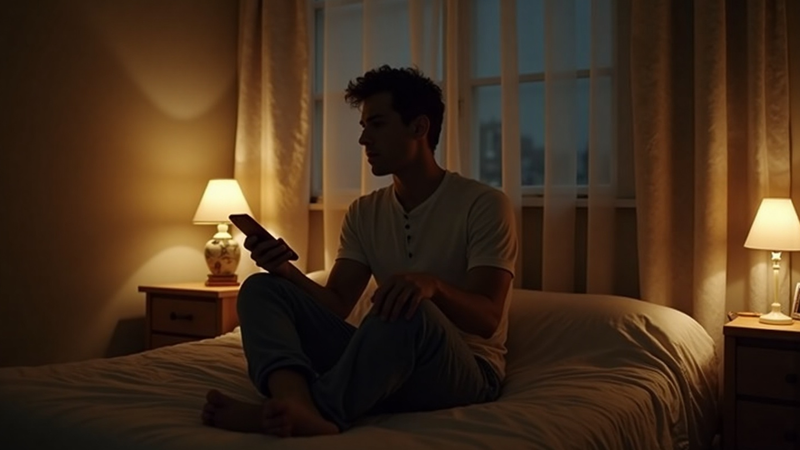

Sleep Anxiety: Why Your Brain Wakes Up at Bedtime, and How to Get Your Nights Back
Why your brain switches on the moment your head hits the pillow — the loop behind sleep anxiety, what quietly makes it worse, and the two CBT-I moves that do the heavy lifting.
In this article
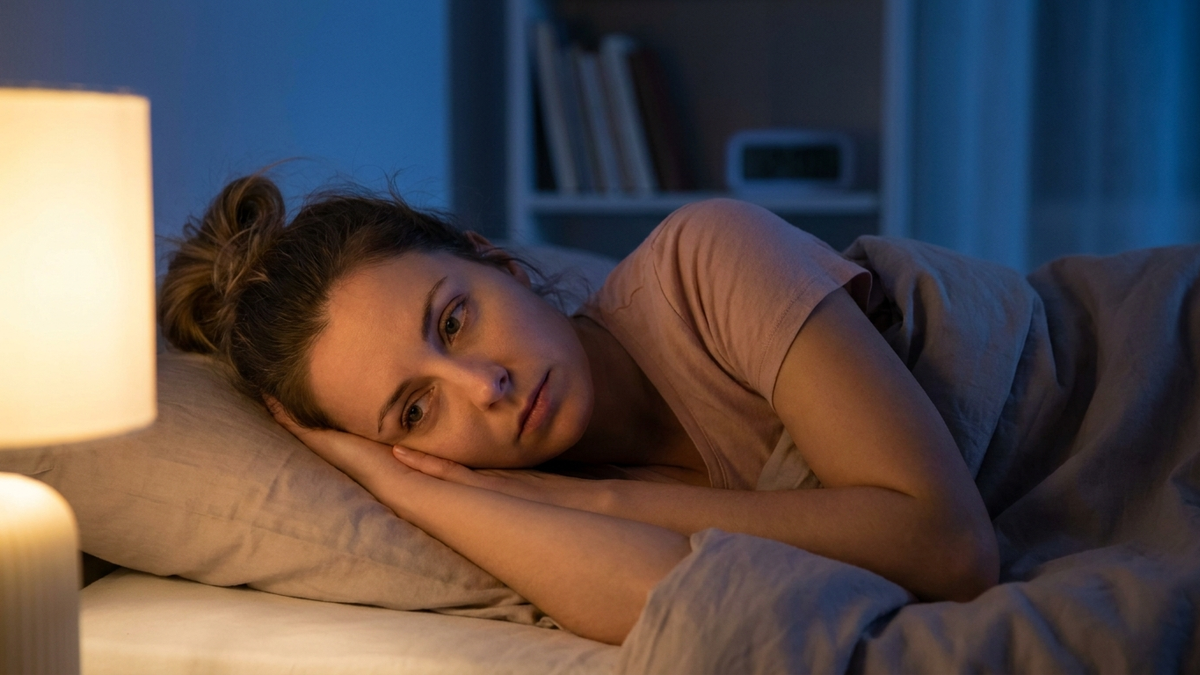
You were exhausted at 9 p.m. You yawned through the last episode. You brushed your teeth already half-asleep. Then your head touched the pillow, and something switched on.
Suddenly you are replaying a conversation from three years ago. You are calculating how many hours of sleep you can still get if you fall asleep right now. You are wondering whether that email sounded rude. And underneath all of it runs one quiet, exhausting thought: what if I don't sleep tonight either?
This is sleep anxiety. Not laziness, not a lack of discipline, not a character flaw. It is a specific, well-documented loop in which worry blocks sleep and lost sleep feeds worry. It has a shape, it has mechanics, and — this is the part most people never hear — it responds to treatment better than almost any other sleep problem.
There is a related pattern where the problem is not falling asleep but going to bed at all: sleep procrastination.
This guide walks through what is actually happening in your body at 2 a.m., why the most obvious solutions make it worse, and what the evidence says works.
What you will learn
What sleep anxiety actually is
Sleep anxiety is worry that centres on sleep itself, or worry that reliably surfaces at bedtime. In practice it shows up in three overlapping forms.
Anticipatory worry about sleep. You start dreading the night in the afternoon. By the time you get into bed you are monitoring yourself: am I drifting off? was that a yawn? it's already 12:40. The monitoring is the problem — you cannot observe yourself falling asleep any more than you can watch yourself forget something.
Bedtime as the first quiet moment of the day. Nothing is wrong with your sleep system at all. It is simply the first time in sixteen hours that nothing is competing for your attention, so everything you postponed arrives at once. For a lot of people this is the entire explanation.
Night-time waking with a racing mind. You fall asleep normally, then surface at 3 a.m. fully alert, heart going, brain already mid-sentence about something you cannot fix before morning.
All three share one engine: your nervous system has been told, correctly or not, that this is not a safe moment to power down.
The difference between sleep anxiety and insomnia
They overlap, but they are not the same thing, and the distinction matters for what you do next.
Insomnia is the outcome: difficulty falling asleep, staying asleep, or waking too early, at least three nights a week for at least three months, with real consequences during the day.
Sleep anxiety is one of the most common engines that produces and maintains that outcome. You can have sleep anxiety for a week after a stressful event and never develop insomnia. You can have insomnia driven mostly by shift work, pain, or a medical condition with very little anxiety attached.
Where they meet is where things get stubborn: a few bad nights create worry about sleep, that worry creates more bad nights, and within a couple of months the original trigger is gone but the loop keeps running on its own.
Why your brain does this: three mechanisms
Hyperarousal — your body thinks you are on duty
Sleep requires a physiological handover: the sympathetic branch of your nervous system (mobilise, act, protect) steps back and the parasympathetic branch (digest, repair, restore) takes over. Heart rate drops. Core temperature falls. Cortisol should be at its daily low.
In sleep anxiety, that handover does not complete. Measured markers of arousal — heart rate, metabolic rate, cortisol, high-frequency brain activity — stay elevated into the night. This is the finding behind the hyperarousal model of insomnia, and it explains an experience that otherwise makes no sense: being physically wrecked and mentally wired at the same time. You are not imagining the contradiction. Your body is tired. Your alarm system is still switched on.
This is also why "just relax" fails as advice. You cannot instruct a threat-detection system to stand down by telling it to.
Rumination — thoughts that circle instead of resolve
Daytime thinking has a natural stopping point: you decide, act, or get distracted. At night none of those are available. So the mind does the only thing left — it loops.
Rumination has a particular quality worth recognising. It feels productive. It feels like you are working on the problem. But circle back honestly: in ten years of 2 a.m. thinking, how many problems were ever solved at 2 a.m.? The content changes — money, health, a relationship, that thing you said in 2019 — and the loop stays identical. That is the tell. The subject is not the point; the looping is.
Anxiety about the anxiety — the loop closes
Here is where a rough patch becomes a chronic pattern.
After a few bad nights, bed stops being neutral. You start bringing expectation into the room: this is where I lie awake. Your brain is an excellent associative learner, and it has now learned that this pillow is a cue for vigilance, not for sleep.
Then comes effort. You go to bed earlier to "catch up". You stay in bed longer in the morning hoping to top up. You try harder to fall asleep. Every one of those moves is intuitive, and every one makes the pattern worse — because effort is arousing, and because spending nine hours in bed to get five hours of sleep teaches your brain that bed is a place for being awake.
What makes it worse without you noticing
Checking the clock. Every glance is a calculation — five hours and twenty minutes left — and every calculation is a small dose of adrenaline. Turn the clock away. If you use your phone as an alarm, put it across the room.
Trying harder. Sleep is one of very few functions that actively resists effort. Nobody has ever fallen asleep by concentrating on falling asleep.
Catching up. Long lie-ins and naps after a bad night reduce your sleep pressure — the biological drive that builds the longer you are awake — so the next night is harder. The loop tightens.
Alcohol as a sedative. It shortens the time to fall asleep and then fragments the second half of the night, suppresses REM, and produces a rebound in arousal around 3 a.m. It is one of the most reliable ways to convert a falling-asleep problem into a waking-up-at-3 problem.
Scrolling in bed. Less about blue light than about content. A social feed is engineered to be arousing; a work email at 11 p.m. hands your brain a problem it cannot act on for nine hours.
Doing everything else in bed. Working, eating, arguing and worrying in bed all dilute the association between that space and sleep.
What actually works: CBT-I
Cognitive behavioural therapy for insomnia is the first-line treatment recommended by major clinical bodies ahead of sleeping medication — not because medication never has a place, but because CBT-I produces improvements that hold after treatment stops, while sleeping pills work while you take them and often stop working over time.
It is not one technique. It is a set of components that work together, and the two that do the heaviest lifting are the two people most often skip.
Stimulus control: give the bed its meaning back
The goal is to rebuild one association: bed equals sleep.
The rules are simple and mildly annoying:
- Go to bed only when sleepy, not merely tired. Sleepy means your eyes are closing on their own.
- If you are still awake after roughly twenty minutes — estimated, not timed — get up and leave the bedroom.
- Do something quiet and dull in low light until you feel genuinely sleepy, then return to bed.
- Repeat as many times as the night demands.
- Get up at the same time every morning regardless of how the night went.
- No screens, work, or problem-solving in bed.
Getting out of bed at 2 a.m. when you are desperate for sleep feels like sabotage. It is the single most effective behavioural component there is. You are teaching your nervous system that the bed is not the place where you lie awake fighting.
Sleep restriction: less time in bed, more actual sleep
Counter-intuitive and highly effective. If you spend nine hours in bed and sleep six, you compress your time in bed towards the six — usually not below five and a half — and hold a fixed wake-up time.
Sleep becomes consolidated and deeper because sleep pressure is high. As the proportion of time in bed that you spend actually asleep climbs past roughly 85–90%, you extend the window by fifteen or twenty minutes at a time.
The first week is genuinely unpleasant. Do it with support if you can, and not at all if you have a seizure disorder, bipolar disorder, or a job where sudden sleepiness is dangerous, without clinical guidance.
Working with the thoughts
Try with Dzeny AI
Ask Dzeny to run a worry window with you: name what is circling, then split it into what you can act on tomorrow and what you cannot act on at all.
Start Free SessionTwo moves matter more than sophisticated thought-challenging.
The first is a worry window: fifteen minutes in the early evening, on paper, away from the bedroom. Write the worry, then write the smallest possible next action and when you will do it. You are not solving your life; you are giving your brain evidence that the material has a scheduled place, so it stops raising it at midnight.
The second is loosening the catastrophic arithmetic. "If I don't sleep, tomorrow is ruined" is the belief that turns a bad night into a bad month. Tomorrow after a bad night is usually mediocre, not ruined — and you have survived every one so far. Aim for accuracy, not positivity.
Down-regulating the body
These do not cause sleep. They lower arousal so that sleep becomes possible.
Extended exhale. Breathe in for four, out for six to eight, for a few minutes. A longer exhale than inhale increases vagal tone and slows the heart. It is the fastest reliable lever you have.
Progressive muscle relaxation. Tense a muscle group for five seconds, release for fifteen, work through the body. It gives a busy mind a physical task and interrupts rumination without requiring you to stop thinking.
Body scan. Move attention slowly through the body with no attempt to change anything. When the mind wanders — it will — return to where you were. The wandering is not failure; the returning is the practice.
The loop runs at 2 a.m., when nobody is awake to text
Dzeny is an AI companion built on CBT principles: separate what is solvable now from what is not, get a worry window you actually do, and see what your nights look like over weeks
Try Dzeny freeNo card required for the trial
Sleep hygiene: useful, but not the treatment
Consistent wake time, a cool dark room, caffeine cut-off eight to ten hours before bed, no heavy meals late, daylight in the morning, movement during the day: all of this helps, and none of it is sufficient.
Sleep hygiene is the floor, not the ceiling. If you have had sleep anxiety for months, better sleep hygiene alone will not resolve it — and being told to fix your sleep hygiene when you have already blacked out the windows and bought the expensive mattress is one of the more demoralising experiences in this whole territory.
The one item worth treating as non-negotiable is the fixed wake-up time. It anchors your circadian rhythm and protects sleep pressure. If you change one thing this week, change that.
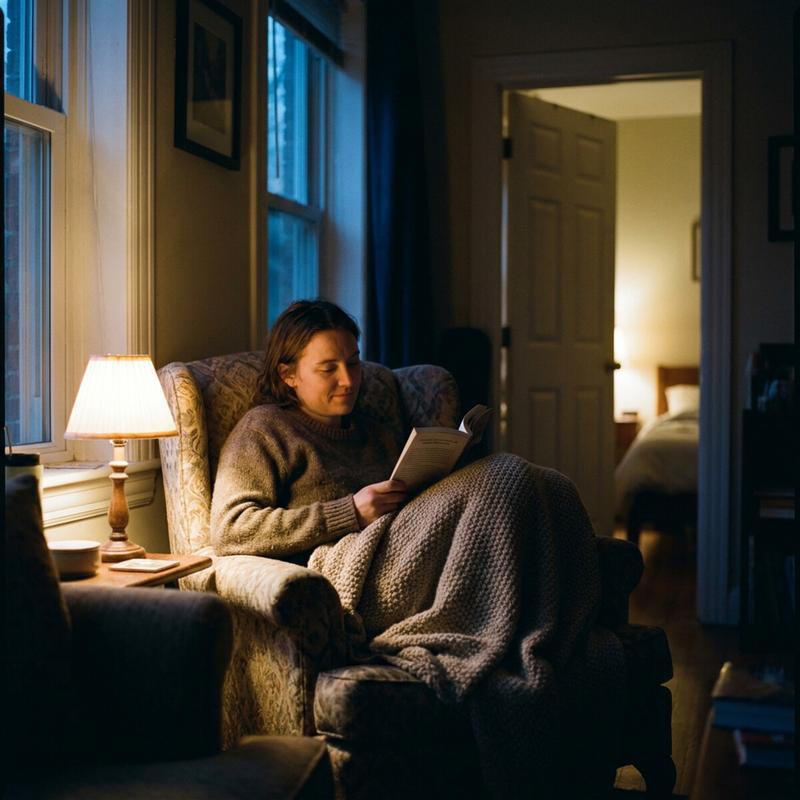
Your first two weeks
Week one — stop feeding the loop. Fix your wake-up time, seven days a week. Turn the clock away. Start the fifteen-minute worry window in the early evening. Get out of bed when you have been awake and frustrated for what feels like twenty minutes. Cut alcohol as a sleep aid. Expect no improvement yet; you are removing fuel, not flipping a switch.
Week two — add pressure and practice. Note roughly how long you actually sleep, and bring your time in bed close to that number with the same fixed wake time. Do extended-exhale breathing for five minutes before bed and again if you wake. Keep the get-out-of-bed rule. Around days ten to fourteen most people notice nights becoming more consolidated — fewer, shorter wakings rather than perfect sleep.
Then extend by fifteen minutes at a time as your nights fill in.
When to get professional help
Talk to a doctor or a sleep specialist if any of the following are true: the problem has run beyond three months and self-directed work has not shifted it; you snore heavily, gasp, or stop breathing in your sleep, or you are sleepy during the day despite adequate time in bed (this needs a sleep apnoea assessment, and treating it as anxiety will not work); you have persistent low mood, loss of interest, or thoughts of harming yourself; you are using alcohol or sedatives to sleep and finding it difficult to stop; or there are unusual behaviours in sleep such as acting out dreams.
If you are in crisis in the US, call or text 988 for the Suicide & Crisis Lifeline. In the UK, call Samaritans on 116 123.
How Dzeny helps at 2 a.m.
The hardest part of sleep anxiety is the timing. The loop runs when nobody is awake to talk to, and by the time you could see someone it has faded into an ordinary tired morning — until it returns that night.
Dzeny is an AI companion built on CBT principles that is available exactly then. You can write what is circling in your head and get a structured response rather than a scroll: help separating what is solvable now from what is not, a worry window you actually do, breathing and relaxation walked through step by step, and a record of what your nights look like over weeks so patterns become visible.
It is not a therapist and does not replace one when clinical care is needed. It is the thing that is there in the hour when nothing else is.
You do not have to wait until morning
Write what is circling in your head and get a structured response instead of a scroll — breathing walked through step by step, and a record of your nights over weeks
Try Dzeny freeNo card required for the trial
Frequently asked questions
How long does it take for CBT-I to work?
Most structured programmes run four to eight weeks, and many people notice a difference in nights ten to fourteen — usually consolidation first, then duration.
Is it dangerous to go a night without sleep?
Unpleasant, not dangerous, for an otherwise healthy person. The fear of the consequences typically does more damage than the lost sleep itself.
Should I take melatonin?
Melatonin is a circadian signal, not a sedative. It helps with jet lag and delayed sleep phase. For anxiety-driven insomnia the effect is usually small. Discuss dose and timing with a clinician.
Are naps allowed?
During active sleep restriction, no — they bleed off the pressure you are building. Once your sleep is stable, a short early-afternoon nap of twenty minutes is fine for most people.
Why do I wake at 3 a.m. specifically?
Sleep lightens in the second half of the night, and cortisol begins rising towards morning. A brief waking is normal; anxiety is what turns a brief waking into two hours.
Can exercise help?
Yes, reliably — regular daytime movement improves sleep quality. Intense training in the two hours before bed raises arousal and core temperature for some people; test it on yourself.
What if my partner sleeps fine and I resent it?
Common and worth naming out loud rather than seething at 4 a.m. Practical fixes — separate duvets, earplugs, occasionally separate rooms — are not a relationship failure.
Does this ever fully go away?
For most people the loop stops being the default. Bad nights still happen under stress; what changes is that they no longer trigger the spiral, because you know what to do with them.
Putting a number on it helps more than it sounds — the Free Anxiety Test gives you a baseline to compare against later.
Sources
- American Academy of Sleep Medicine — clinical practice guidelines on the behavioural and psychological treatment of chronic insomnia
- American College of Physicians — clinical guideline on the management of chronic insomnia in adults
- Riemann et al. — the hyperarousal model of insomnia, *Sleep Medicine Reviews*
- Harvey — a cognitive model of insomnia, *Behaviour Research and Therapy*
- NICE guidance on insomnia assessment and management
Important
This article is for information only and does not replace diagnosis or treatment by a qualified professional. If you are in crisis, contact your local emergency service — in the US, call or text 988; in the UK, call Samaritans on 116 123.

Written by
Valentina Lipskaya
Clinical Psychologist · Gestalt Therapist · CBT Specialist · ICF Certified Coach · MBA Professor
Panic Disorder, Anxiety, CBT & Gestalt Therapy
Valentina Lipskaya is a certified clinical psychologist and gestalt therapist specializing in panic disorders, anxiety, and neurological conditions. With over 15 years in psychology and 7 years of hands-on clinical practice, she has helped more than 750+ clients overcome panic, chronic anxiety, and psychosomatic conditions — without medication. Her work at Dzeny translates evidence-based therapeutic methods into practical, accessible guidance for everyday mental health.