
Sleep procrastination: why we scroll instead of sleeping
Bedtime procrastination is not a discipline problem. Why you stay up when you are exhausted, what the scrolling is actually doing for you, and what changes it.
In this article
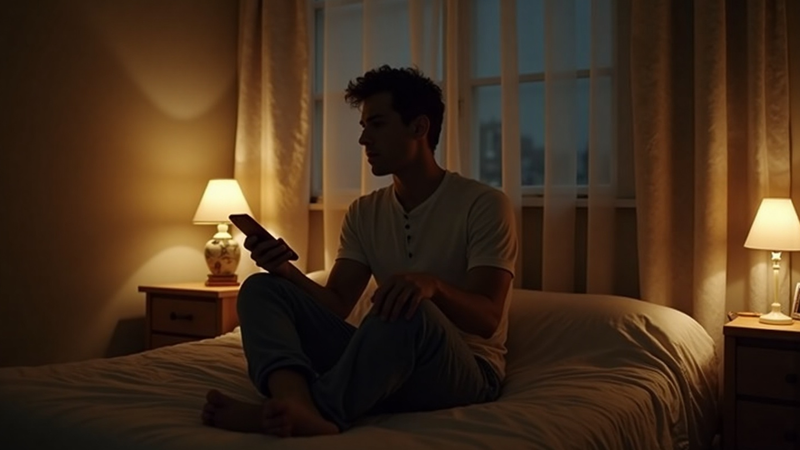
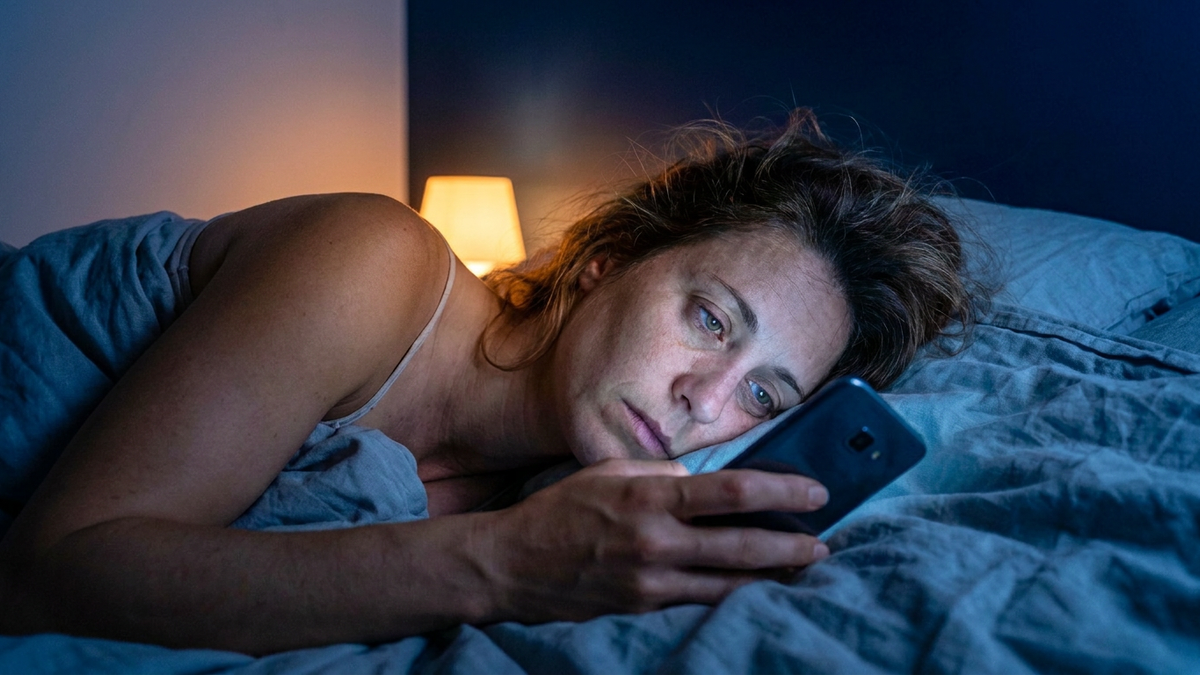
You are tired. You have been tired since four in the afternoon. You know exactly how you will feel tomorrow if you stay up. And still, at half past midnight, you are watching a video about restoring a chair you will never own.
This has a name — bedtime procrastination — and it is not a discipline problem. It is one of the most rational irrational behaviours there is, once you see what it is actually doing for you.
What is really happening at midnight
You are buying back time that was taken from you.
If the trouble starts once you are already in bed, that is a different mechanism — see sleep anxiety.
For most people the day is spoken for. Work, commute, children, chores, obligations. The first genuinely unclaimed hour arrives when everyone else is asleep. Giving it up means going to bed having had no time that belonged to you at all — and something in you refuses. Researchers call it revenge bedtime procrastination, and the word "revenge" is accurate: it is retaliation against a day you did not control.
Your self-control has run out for the day.
Willpower is not a character trait, it is a resource that depletes. All day you have been overriding impulses: not saying the thing, staying at the desk, being patient. By eleven at night the mechanism that would normally say "put the phone down" is simply not staffed.
The transition itself is the hard part.
Going to bed is not one decision, it is a chain of them: stop the video, get up, brush teeth, change, turn off the light, lie in the dark with your thoughts. People who procrastinate sleep rarely resist sleep — they resist that chain. And the last link is the real one.
For anxious people, the dark is when thinking starts.
If your day is busy enough to keep worry at bay, bed is the first place with nothing to drown it out. Scrolling is not entertainment then. It is avoidance, and it works — right up until it doesn't.
Why the phone specifically
It is not that screens are uniquely evil. It is that a feed is the only activity precisely engineered to have no ending. A book has chapters, an episode has credits, a conversation has a goodbye. A feed has none, and your brain never gets the signal that says "this is finished, you can stop now."
Add to that the fact that each new item delivers a small, unpredictable reward — the same schedule that makes slot machines work — and you have a system that could hold a well-rested person, let alone an exhausted one.
What does not work
Going to bed earlier. If the problem is unclaimed time, an earlier bedtime removes more of it and increases the resistance.
Willpower rules. "No phone after ten" fails for the same reason diets fail at 9pm: you are asking the depleted system to police itself.
Blaming yourself in the morning. Shame reliably predicts doing it again. It also adds a layer of dread to the evening, which is precisely when you need less to avoid.
What actually helps
Give yourself the hour on purpose, earlier.
The need is real; the timing is the problem. Take a deliberate, protected hour before dinner — no chores, no admin. People often report the midnight pull weakens dramatically once the day contains one hour that is genuinely theirs.
Make the transition one step instead of six.
Prepare the chain in advance: phone charging in another room, clothes out, teeth done before you sit down for the evening. Then going to bed is a single action, not a project.
Replace, don't remove.
Cutting the phone with nothing in its place leaves you alone with the exact thoughts you were avoiding. A paper book, a podcast with an end, a short written brain-dump of tomorrow's worries — anything with a boundary.
Set an end signal, not a start time.
Instead of "bed at 11", use "the last video ends at 11". The feed has no ending, so you have to supply one.
Deal with the anxiety directly if it is anxiety.
If lying in the dark reliably starts a spiral, the scrolling is a symptom. Writing the worries down before bed, or talking them through, does more than any screen rule.
When it is worth taking seriously
- you are losing more than an hour of sleep most nights for weeks;
- you fall asleep fine but cannot get yourself to go to bed;
- daytime functioning is affected — concentration, mood, driving;
- you wake early and cannot get back to sleep, on top of the late nights;
- the evening dread is growing.
Chronic short sleep is not a lifestyle quirk. It is associated with anxiety, depression and cardiometabolic risk, and it is one of the most fixable inputs into all three.
If you are not sure whether this is ordinary stress or something more persistent, the Free Anxiety Test is a quick place to start.
The short version
Staying up is rarely about sleep. It is about the fact that the day gave you nothing of your own, and midnight is the only place left to take it back. Fix that, and the phone loses most of its grip. Fight the phone alone, and you are arguing with a symptom.
References
- 1.Kroese F. et al.. Kroese F. M. et al. — Bedtime procrastination: introducing a new area of procrastination, Frontiers in Psychology, 2014 (2014)
- 2.Kroese F. et al.. Kroese F. M. et al. — Bedtime procrastination: a self-regulation perspective on sleep insufficiency, Journal of Health Psychology, 2016 (2016)
- 3.National Institute of Mental Health. Anxiety Disorders, 2024 (2024)
- 4.Sleep Foundation. Revenge bedtime procrastination, 2024 (2024)
- 5.Centers for Disease Control and Prevention. About Sleep, 2024 (2024)
Frequently Asked Questions

Written by
Valentina Lipskaya
Clinical Psychologist · Gestalt Therapist · CBT Specialist · ICF Certified Coach · MBA Professor
Panic Disorder, Anxiety, CBT & Gestalt Therapy
Valentina Lipskaya is a certified clinical psychologist and gestalt therapist specializing in panic disorders, anxiety, and neurological conditions. With over 15 years in psychology and 7 years of hands-on clinical practice, she has helped more than 750+ clients overcome panic, chronic anxiety, and psychosomatic conditions — without medication. Her work at Dzeny translates evidence-based therapeutic methods into practical, accessible guidance for everyday mental health.