

Postpartum Anxiety: A Complete, Compassionate Guide to Worry, Intrusive Thoughts, and Panic After Birth
Postpartum anxiety: signs, intrusive thoughts, and how to cope.

In this article
If you have a new baby and your mind feels like it never stops scanning for danger, you are not broken, and you are not alone. Maybe you lie awake listening for every breath your baby takes. Maybe a frightening image flashes through your mind and leaves you shaken. Maybe your heart races for no reason you can name. This is more common than most people realize, and it has a name: postpartum anxiety.
In this guide, you will learn what postpartum anxiety actually is, how it differs from the ordinary worry that comes with caring for a newborn, and how it is distinct from postpartum depression. You will get a clear picture of the symptoms — physical, mental, and the unsettling intrusive thoughts that so many new parents are too afraid to mention — along with why it happens, who is more at risk, and what genuinely helps.
Here is one grounding reframe before we begin: having anxious thoughts, even disturbing ones, does not make you a bad parent. In fact, the worry usually comes from how deeply you love this small person. Postpartum anxiety is a treatable condition, not a character flaw, and needing support does not mean you are failing. You do not have to white-knuckle your way through this alone.
Key takeaways
Postpartum anxiety is relentless, hard-to-control worry after birth — distinct from ordinary new-parent vigilance and from postpartum depression. Frightening intrusive thoughts are a common symptom and do not mean you are dangerous or a bad parent. It is very treatable with therapy, support, and sometimes medication, and reaching out early usually means faster relief.
What Is Postpartum Anxiety?
Postpartum anxiety is excessive, persistent worry and fear that occurs after having a baby. It is one of the perinatal mood and anxiety disorders — a group of conditions that can affect people during pregnancy and in the year after birth. While some worry is a natural part of caring for a fragile newborn, postpartum anxiety is worry that becomes constant, hard to control, and disruptive to your daily life and rest.
It can show up on its own, or alongside postpartum depression. It affects people of every background, birth experience, and family situation, and it does not discriminate based on whether you have other children, how much you wanted this baby, or how "together" you seem on the outside. Research suggests anxiety disorders in the postpartum period are common, and yet they are frequently under-recognized, in part because new-parent exhaustion and worry are so often waved off as normal.
It is not a sign of weakness or bad parenting
One of the cruelest things about postpartum anxiety is how much shame tends to travel with it. Many parents privately believe their fear means something is wrong with them, so they stay quiet. Please hear this clearly: a racing, worried mind after birth is a recognized medical experience, not a moral one. Your brain, flooded with hormones and running on fractured sleep, has essentially turned its threat-detection system up too high. That is biology and circumstance — not a verdict on your worth as a parent.
How Postpartum Anxiety Differs From "Normal" New-Parent Worry
Every new parent worries. You check on the baby, you read about milestones, you feel a jolt when the car seat clicks a little differently than you expected. That kind of worry is protective and expected. The question is not whether you worry, but whether the worry has taken the wheel.
When worry crosses the line
Normal new-parent worry tends to come and go, respond to reassurance, and settle once a concern is addressed. Postpartum anxiety feels different. The worry is often relentless and hard to switch off, even when everything is objectively fine. It may jump from one fear to the next, so that solving one worry only clears space for another. Reassurance helps for a moment, then the anxiety returns. And crucially, it starts to cost you — your sleep, your appetite, your ability to enjoy your baby, or your capacity to leave the house.
A useful rule of thumb: if your worry is frequent, feels uncontrollable, and is interfering with your functioning or your rest, it has moved beyond ordinary vigilance into something worth taking seriously and treating.
The exhaustion trap
Sleep deprivation muddies all of this. When you are profoundly tired, your body already produces symptoms that mimic anxiety — a fast heartbeat, irritability, difficulty concentrating, a sense of being on edge. That overlap can make postpartum anxiety harder to spot, both for you and for the people around you. It is worth remembering that "I'm just tired" and "I have postpartum anxiety" are not mutually exclusive, and profound tiredness can amplify anxiety considerably.
Postpartum Anxiety vs Postpartum Depression
These two conditions are often mentioned in the same breath, and they can absolutely occur together, but they are not the same thing. Understanding the difference can help you name what you are experiencing and find the right support.
Different emotional centers of gravity
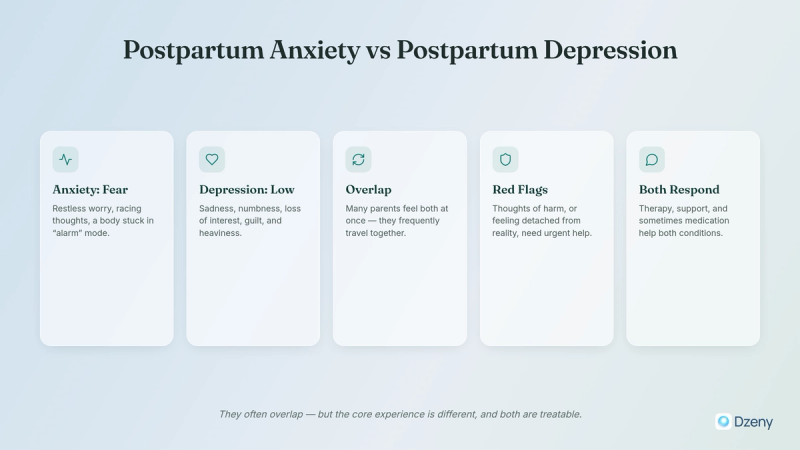
Postpartum depression tends to center on low mood: persistent sadness, emptiness, loss of interest or pleasure, feelings of worthlessness or guilt, and sometimes a sense of disconnection from the baby. Postpartum anxiety centers on fear and worry: a mind that races, a body that stays keyed up, and a persistent sense that something bad is about to happen. Depression can feel like heaviness and shutting down; anxiety can feel like restless overdrive.
In practice, many people experience a blend of both — a low, flat mood alongside a churning, anxious mind. That mix is common and valid, and it does not mean you have to sort yourself into one tidy box before you can ask for help.
Why the distinction matters
The reason it helps to tell them apart is that the emphasis of treatment can differ. Both often respond well to therapy and, when appropriate, medication, but the specific skills and approaches may be tailored differently. Naming anxiety as anxiety also spares you the frustration of feeling like a "depression" label does not quite fit. Whichever it is — or if it is both — a clinician who works with perinatal mental health can help you find the right path. If your experience leans more toward heaviness and low mood, our guide to postpartum depression walks through the signs and what helps.
Common Symptoms of Postpartum Anxiety
Postpartum anxiety wears many faces. It can be loud and physical, quiet and mental, or dominated by frightening thoughts that catch you off guard. Recognizing the range can be reassuring in itself — because naming something often loosens its grip.
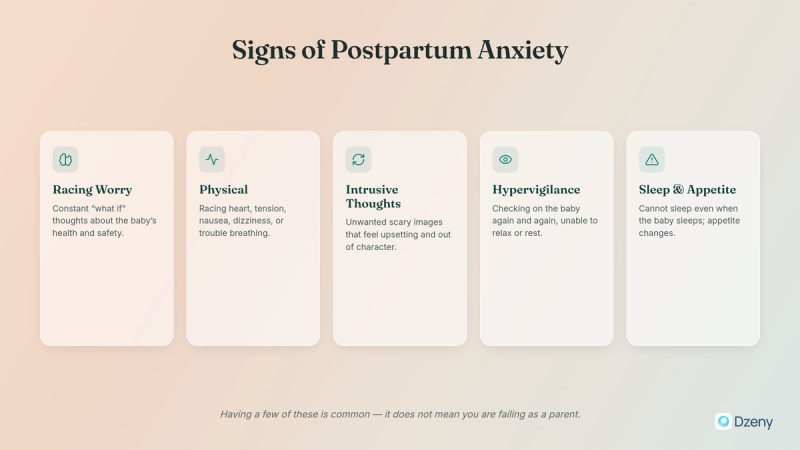
Physical symptoms
Anxiety lives in the body as much as the mind. You might notice a racing or pounding heart, shortness of breath, or a tight chest. Some people feel dizzy, shaky, or nauseated. Muscle tension, headaches, a churning stomach, and a constant sense of restlessness are common. Many parents describe being unable to sleep even when the baby is finally asleep, because their body simply will not power down. Others lose their appetite entirely.
Mental and emotional symptoms
On the inside, postpartum anxiety often sounds like a mind that will not stop. There may be constant "what if" thinking, a tendency to imagine worst-case scenarios, and difficulty concentrating or making even small decisions. You might feel irritable, on edge, or unable to relax. Some parents find themselves compulsively checking on the baby, seeking reassurance again and again, or avoiding situations that feel risky. There is often a background hum of dread that is hard to explain to anyone who has not felt it.
Intrusive thoughts — the symptom no one warns you about
This is the part many parents are terrified to say out loud, so let's be direct and gentle about it. Intrusive thoughts are unwanted, distressing images or ideas that pop into your mind without your consent — often involving harm coming to the baby. A parent might suddenly picture dropping the baby on the stairs, or imagine something terrible happening, and feel horrified by their own mind.
If this is happening to you, please take a breath, because here is what matters most: these thoughts are extremely common in postpartum anxiety, and having them does not mean you want to act on them or that you are dangerous. In fact, the very distress they cause is a sign of how much you care. Intrusive thoughts in anxiety are ego-dystonic — meaning they feel alien and repellent to you, the opposite of your intentions. The typical response is to become hypervigilant and to avoid the trigger, not to act. Naming this openly with a professional almost always brings relief, not judgment.
It's 3 a.m., the baby is finally asleep, and your mind won't stop.
Dzeny is an AI companion built on cognitive behavioral therapy principles that can help you name a frightening thought, put worry into words, and steady your breathing in the exact moment it hits — privately, with no judgment, any hour of the day or night.
Talk to DzenyNo sign-up or card needed
Why Postpartum Anxiety Happens
There is no single cause, and it is never something you brought on yourself. Postpartum anxiety usually arises from several forces converging at once, at a uniquely vulnerable moment in life.
Hormones
Pregnancy and birth involve dramatic hormonal shifts. Levels of estrogen and progesterone drop steeply after delivery, and other hormones involved in stress, mood, and bonding are in flux. For some people, these rapid changes appear to influence the brain's regulation of mood and anxiety, tipping a sensitive nervous system toward a heightened, alert state.
Sleep deprivation and physical recovery
Few things destabilize mental health like sustained lack of sleep, and newborn care all but guarantees it. On top of that, your body is recovering from pregnancy and birth, which is physically demanding in its own right. A depleted, under-slept body is far more prone to anxiety, because the systems that would normally help you regulate stress are running on empty.
Life change and the weight of responsibility
Becoming a parent, or adding another child, is one of the largest life transitions there is. Your routines, identity, relationships, and sense of control all shift at once. Suddenly a small, dependent human relies on you completely. It is entirely understandable that a mind facing this much change and responsibility might overshoot into worry. Add social isolation, financial pressure, or a difficult birth experience, and the load grows heavier still.
Who Is More at Risk?
Postpartum anxiety can affect anyone, but certain factors make it more likely. Knowing them is not about blame — it is about awareness, so you and the people around you can watch for it and respond early.
Risk tends to be higher if you have a personal or family history of anxiety, depression, or obsessive-compulsive disorder. A history of previous perinatal mood or anxiety difficulties raises the odds, as does a history of pregnancy loss, fertility struggles, or a traumatic birth. Other contributing factors can include limited social or partner support, significant life stress, sleep deprivation, and a temperament that leans toward worry or perfectionism. Parents of babies with health concerns or feeding difficulties, and those navigating major financial or relationship strain, may also be more vulnerable.
Importantly, plenty of people with several risk factors never develop postpartum anxiety, and some with none do. Risk factors describe probabilities, not destiny — and they say nothing about your strength or your love for your child.
When It Is an Emergency: Red Flags and Related Conditions
Most postpartum anxiety, while distressing, is not dangerous and responds well to support. But there are a few situations that warrant urgent attention, and it is important to name them clearly rather than leave you guessing.
Postpartum OCD
Some people experience postpartum obsessive-compulsive disorder, where the intrusive thoughts described earlier become especially frequent and are paired with compulsions — repetitive behaviors or mental rituals meant to neutralize the fear, such as constant checking, cleaning, or seeking reassurance. Postpartum OCD is treatable, and the intrusive thoughts, though horrifying to the person experiencing them, are not a sign of danger to the baby. If checking and rituals are taking over your day, tell your clinician; effective help exists.
Postpartum psychosis — a medical emergency
Postpartum psychosis is rare but serious, and it is different from postpartum anxiety. It can involve confusion, losing touch with reality, hallucinations, delusions, extreme agitation, or thoughts of harming yourself or the baby that feel compelling rather than horrifying. This is a medical emergency. If you or someone you love shows these signs, seek emergency help immediately — call your local emergency number or go to the nearest emergency department. It is treatable, and rapid help matters.
Any thoughts of harming yourself or your baby
If you ever have thoughts of harming yourself or your baby that feel like urges rather than unwanted, frightening intrusions, do not wait. Reach out right away to a crisis line, an emergency service, or a trusted person who can stay with you and help you get care. Asking for urgent help in that moment is an act of protection, for both you and your child.
When to get help urgently
Postpartum psychosis, or any thoughts or urges to harm yourself or your baby, is a medical emergency — do not wait, and do not stay alone with it. Seek help immediately: in the US, call or text 988 (Suicide & Crisis Lifeline), available 24/7, or go to your nearest emergency department; outside the US, contact your local emergency services or a crisis line. This article is for information only and is not a substitute for professional medical or psychological care.
How Postpartum Anxiety Is Treated
Here is the hopeful heart of this article: postpartum anxiety is very treatable. Most people improve significantly with the right support, and treatment is usually tailored to your severity, your preferences, and your circumstances — including whether you are breastfeeding.
Therapy and CBT
Talking therapy is a first-line treatment, and cognitive behavioral therapy (CBT) has strong support for anxiety. CBT helps you recognize the anxious thought patterns fueling the worry, gently test them against reality, and build practical skills for calming your body and responding differently to fear. For intrusive thoughts and OCD-type symptoms, specific approaches such as exposure and response prevention can be remarkably effective. Many people find enormous relief simply from a skilled therapist normalizing their intrusive thoughts and explaining what is happening.
Support and connection
Anxiety thrives in isolation, and new parenthood can be lonely. Peer support groups, whether in person or online, connect you with others who truly understand. Practical support — someone to hold the baby so you can nap, share the night feeds, or simply sit with you — is not a luxury; it is part of recovery. Reducing your load and increasing your rest directly lowers the fuel available to anxiety.
Medication (a brief overview)
For moderate to severe symptoms, medication can be an important part of treatment, and it is worth discussing openly with a doctor. Certain antidepressants, particularly SSRIs, are commonly used for perinatal anxiety, and many are considered compatible with breastfeeding, though the decision is individual. This is a conversation to have with a qualified prescriber who can weigh the benefits and any considerations for your situation. Medication is not a last resort or a sign of weakness — for many people it is what makes the other work possible.
Self-help alongside professional care
Self-help strategies work best as a companion to professional support, not a replacement for it. Gentle daily practices — which we will get into next — can steady your nervous system and give you a sense of agency between appointments. For everyday tools, you might explore practical strategies for how to deal with anxiety and simple techniques you can use in the moment.
A Practical Self-Help Section: Gentle Steps That Help
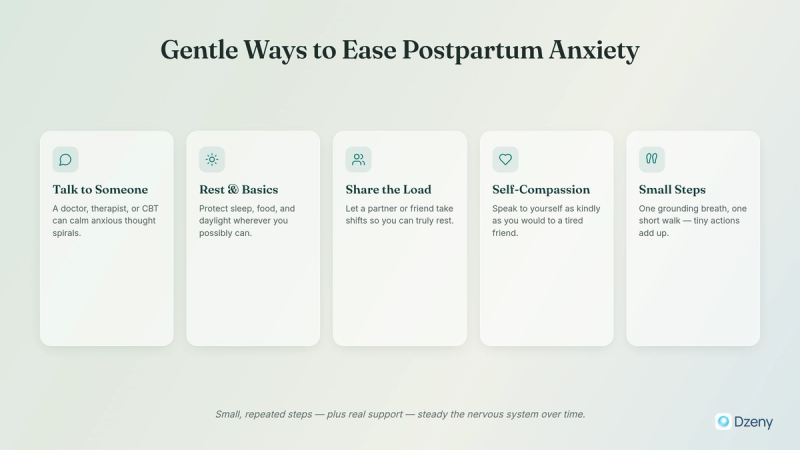
None of these will "fix" postpartum anxiety on their own, and they are not a substitute for professional care when you need it. But they are kind, doable steps that can soften the edges on a hard day. Take what helps and leave the rest.
Protect your sleep wherever you can
Sleep is not optional maintenance; it is medicine for an anxious brain. Where possible, trade off night feeds with a partner or support person, nap when the baby naps even if it feels unproductive, and lower the bar on everything non-essential. Even modest gains in rest can noticeably calm the nervous system. Ask for help with this specifically — it is one of the highest-value things anyone can offer you.
Use your breath to signal safety
When your body is in alarm, slow breathing tells it the danger has passed. A simple practice is to make your exhale longer than your inhale — breathe in for a count of four, out for a count of six — for a minute or two. It will not erase the worry, but it can turn the volume down. You can find more structured techniques in these breathing exercises for anxiety to keep on hand for the harder moments.
Name intrusive thoughts for what they are
When a frightening thought appears, try silently labeling it: "That's an intrusive thought, not a wish and not a plan." You do not have to argue with it, analyze it, or push it away — struggling with these thoughts tends to make them stickier. Letting them pass through, like an unwelcome text you choose not to answer, gradually loosens their power. This is one of the most relieving skills a therapist can teach, and you can begin practicing it now.
Gently reduce reassurance-seeking and checking
Constant checking and reassurance can feel like relief, but they quietly feed the anxiety by teaching your brain that the fear was warranted. You do not have to stop cold turkey. Instead, try adding a small pause before you check "one more time," and notice that the discomfort rises and then falls on its own. Doing this with a therapist's guidance is ideal, but even small experiments can help.
Move your body and step outside
A short walk, ideally in daylight, does more than you might expect. Gentle movement burns off some of the physical charge of anxiety, and daylight helps regulate mood and sleep. Even five minutes on the doorstep with the baby counts. The goal is not fitness — it is giving your keyed-up system somewhere to go.
Lower the bar and let some things go
Anxiety often teams up with perfectionism, whispering that you must do everything right. You do not. A fed baby and a resting parent beat a spotless house every time. Deliberately dropping non-essential tasks is not laziness; it is triage that protects your mental health during an intense season. Learning to meet yourself with a bit of self-compassion — the same kindness you would offer a struggling friend — is one of the most protective things you can practice right now.
Stay connected, even in small ways
Isolation feeds anxiety. A short text to a friend, a few minutes in a parent group, or simply saying out loud to someone "I'm having a hard time" can interrupt the spiral. You do not need a solution from them — being witnessed is often enough to feel a little lighter.
Some days you have no free hand and no one to call.
Between appointments, Dzeny can walk you through a CBT-based grounding exercise, help you challenge an anxious "what if," or just listen without judgment — a private, always-on companion that fits into one-handed moments while you hold the baby.
Talk to DzenyNo sign-up or card needed
Supporting a Partner With Postpartum Anxiety
If someone you love is going through this, your steadiness matters enormously — and you do not have to fix it to help. Often the most powerful thing you can offer is calm, non-judgmental presence.
Start by listening without minimizing. Avoid "just relax" or "there's nothing to worry about"; instead try "that sounds really hard, and I'm here." Take on concrete load: handle night feeds so they can get an unbroken stretch of sleep, manage meals and chores, and make space for them to rest or see a professional. If they confide an intrusive thought, respond with warmth rather than alarm — remember that sharing it is a sign of trust and that these thoughts are a known feature of anxiety, not a danger signal.
Gently encourage professional support, and offer to help make the call or attend an appointment. Watch, too, for the red flags described earlier — if you see signs of postpartum psychosis or any urges to cause harm, treat it as an emergency and seek immediate help. And look after yourself along the way; supporting someone through this is demanding, and you deserve support too.
When to Reach Out for Professional Help
You do not need to wait until things are unbearable to ask for help. It is worth reaching out if worry is constant and hard to control, if it is interfering with your sleep, appetite, or ability to enjoy your baby, if intrusive thoughts are distressing you, or if the anxiety has lasted more than a couple of weeks. A good first step is your doctor, midwife, health visitor, or a perinatal mental health specialist — and there is no threshold of "bad enough" you have to hit first.
Reaching out is not an admission of failure. It is one of the most caring things you can do, for yourself and for your baby, and it very often marks the beginning of feeling like yourself again.
How Dzeny can help
If you would like warm, always-available support alongside professional care, Dzeny is an AI mental-health companion built on cognitive behavioral therapy (CBT) principles, with calming exercises and guided practices available 24/7 — for the 3 a.m. moments when the worry is loudest and no one else is awake. In an eight-week study with Synergy University Dubai involving 280 adults, participants using Dzeny reported a 43% reduction in anxiety symptoms, and the platform now supports more than 48,000 users. It is not a replacement for a human therapist, your doctor, or emergency care, but it can be a judgment-free place to steady yourself, learn skills, and check in between the harder moments.
Frequently Asked Questions
What is postpartum anxiety?
Postpartum anxiety is excessive, persistent worry and fear that occurs after having a baby. It can involve constant "what if" thinking, physical symptoms like a racing heart, and sometimes frightening intrusive thoughts. It is a recognized perinatal mental health condition, it is common, and it is very treatable with the right support.
How is postpartum anxiety different from postpartum depression?
Postpartum depression centers on low mood — sadness, emptiness, loss of interest, and guilt — while postpartum anxiety centers on fear and worry, with a racing mind and a body that stays on edge. The two often overlap, and many people experience both at once. Either way, a clinician who works with perinatal mental health can help.
Are intrusive thoughts about my baby normal in postpartum anxiety?
Yes. Unwanted, distressing thoughts or images of harm coming to the baby are very common in postpartum anxiety, and having them does not mean you want to act on them or that you are dangerous. They feel alien and horrifying precisely because they go against everything you want. Sharing them with a professional usually brings relief, not judgment.
When should I seek help for postpartum anxiety?
Reach out if your worry is constant and hard to control, if it is disrupting your sleep, appetite, or ability to enjoy your baby, if intrusive thoughts are distressing you, or if symptoms have lasted more than a couple of weeks. You do not need to wait until it becomes severe — earlier support usually means faster relief.
What is the difference between postpartum anxiety and postpartum psychosis?
Postpartum anxiety involves worry and unwanted, distressing thoughts that horrify you. Postpartum psychosis is rare and serious, involving confusion, losing touch with reality, hallucinations or delusions, and thoughts of harm that feel compelling rather than frightening. Postpartum psychosis is a medical emergency — seek immediate help if you see those signs.
How is postpartum anxiety treated?
Treatment often includes cognitive behavioral therapy (CBT), which builds skills for managing anxious thoughts, along with peer and practical support. For moderate to severe symptoms, medication such as certain SSRIs may help, and many are considered compatible with breastfeeding. Self-help practices work best alongside professional care, not instead of it. An AI companion like Dzeny can offer daily support and skills between appointments, but it does not replace professional care, especially for severe symptoms.
Can postpartum anxiety go away on its own?
Milder symptoms sometimes ease as sleep and routines settle, but persistent or worsening anxiety usually improves faster with support, and it should not be ignored. Treatment is effective, and there is no benefit to suffering in silence. If symptoms are interfering with your life, reaching out is worthwhile.
How can I support my partner with postpartum anxiety?
Listen without minimizing, take on concrete load like night feeds and chores so they can rest, and respond to any shared intrusive thoughts with warmth rather than alarm. Gently encourage professional support and offer to help arrange it. Watch for red flags such as signs of postpartum psychosis, and seek emergency help if they appear.
Putting a number on it helps more than it sounds — the Free Anxiety Test gives you a baseline to compare against later.
Sources
- Postpartum Support International — postpartum.net
- National Institute of Mental Health (NIMH) — nimh.nih.gov
- American College of Obstetricians and Gynecologists (ACOG) — Perinatal mental health
- NHS — Mental health after having a baby, nhs.uk
- Mayo Clinic — Postpartum depression and perinatal anxiety
- American Psychological Association (APA) — apa.org
- Dzeny x Synergy University Dubai clinical study (280 adults, 8 weeks)
Written by the Dzeny clinical team. Reviewed by Valentina Lipskaia, Clinical Psychologist & Founder of Dzeny.

Written by
Valentina Lipskaya
Clinical Psychologist · Gestalt Therapist · CBT Specialist · ICF Certified Coach · MBA Professor
Panic Disorder, Anxiety, CBT & Gestalt Therapy
Valentina Lipskaya is a certified clinical psychologist and gestalt therapist specializing in panic disorders, anxiety, and neurological conditions. With over 15 years in psychology and 7 years of hands-on clinical practice, she has helped more than 750+ clients overcome panic, chronic anxiety, and psychosomatic conditions — without medication. Her work at Dzeny translates evidence-based therapeutic methods into practical, accessible guidance for everyday mental health.